

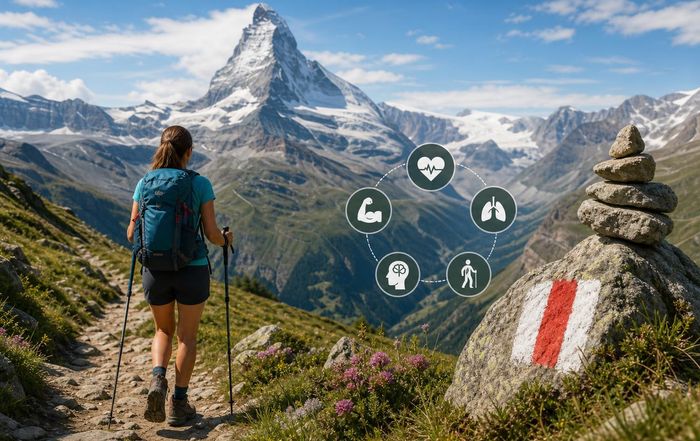
Hiking in Switzerland: Fitness, Mountain Culture, and Trail Etiquette
Hiking in Switzerland sits at a rare intersection of elite sport, everyday fitness, and deep-rooted mountain culture. From lakeside promenades in Lucerne to high-alpine traverses above Zermatt, the country's 65,000-plus kilometers of marked trails are used by everyone from ultra-runners to multi-generational families. For active people visiting or living in Switzerland, understanding how to use this network for fitness-and how to behave on the trails-matters just as much as picking the right route. This guide looks at the real training benefits of Swiss hiking, how to use it as structured conditioning, and the etiquette that keeps shared mountain spaces safe, respectful, and sustainable.
Why Switzerland is a natural outdoor gym
Switzerland's trail system is unusually well organized. The Schweizer Wanderwege (Swiss Hiking Federation) works with cantons and municipalities to maintain a dense, standardized network of yellow signposted hiking routes, with more technical alpine and mountain paths marked in white-red-white or white-blue-white. This means that within a short train ride of major cities like Zurich, Geneva, and Bern, hikers can access everything from gentle valley walks to steep, quad-burning climbs that rival structured hill workouts in a gym.
Because public transport is tightly integrated with outdoor recreation, it is common to step off a train directly at a trailhead and finish a route at another station or cable car. Organizations such as Switzerland Tourism and Swiss Travel System promote this model as part of the country's low-car mobility culture, and it has a practical impact on training: athletes can plan point-to-point hikes with specific elevation gain, distance, and time targets without needing to loop back to a parked car. For visitors, this makes it realistic to use a hiking holiday as a structured fitness block rather than just a scenic break.
The country's terrain diversity also supports progressive overload-the foundation of any effective training plan. Beginners can start on lakeside or valley trails with minimal elevation, then gradually move to rolling foothills in regions like the Emmental or Appenzell, and eventually to high-alpine routes in the Bernese Oberland or Engadine. For endurance athletes, this range offers a natural ladder of difficulty, similar to periodized training in a gym or on the track, but with the added load of altitude and uneven terrain that challenges stabilizing muscles and cardiovascular capacity in ways indoor equipment rarely replicates.
Cardiovascular and muscular benefits of Swiss-style hiking
From a fitness perspective, hiking is a form of low-impact, rhythmic endurance work similar in intensity to brisk walking or light running, but with the added resistance of elevation gain. Research summarized by bodies such as the World Health Organization and American Heart Association shows that regular moderate-intensity aerobic activity improves VO₂ max, lowers resting heart rate, and reduces risk factors for cardiovascular disease. Swiss hiking routes, with their long, sustained climbs, make it easier to stay in a moderate-to-vigorous heart rate zone for extended periods without the impact stress of road running.
Uphill sections primarily target the quadriceps, glutes, and calves, while downhill stretches load the eccentric strength of the quadriceps and demand greater neuromuscular control. Use of trekking poles adds a significant upper-body component, engaging the shoulders, triceps, and core in a pattern similar to cross-country skiing. Studies highlighted by the American College of Sports Medicine indicate that walking with poles can increase energy expenditure without a proportionate rise in perceived exertion, which is valuable for athletes trying to accumulate more training volume while managing fatigue.
The varied terrain of Swiss trails also trains proprioception and ankle stability. Roots, rocks, and variable gradients force the smaller muscles of the feet and lower legs to react constantly, which can be protective against common overuse injuries seen in runners and team-sport athletes. For readers focused on athletic performance, this makes hiking a form of sport-specific strength and conditioning, particularly for trail runners, skiers, and field-sport players who rely on strong, stable lower limbs.
For those prioritizing general health rather than performance, regular hiking contributes meaningfully to the weekly 150-300 minutes of moderate aerobic activity recommended by the WHO. The psychological benefits are also non-trivial: exposure to nature, especially environments with water and expansive views, has been linked by institutions such as Harvard T.H. Chan School of Public Health to reduced stress, improved mood, and better sleep, all of which indirectly support training quality and recovery.
If you are integrating hiking into a broader fitness routine, Swiss trails can complement gym-based strength work and urban running or cycling. On rest weeks from high-intensity training, swapping hard intervals for moderate-effort hikes allows athletes to maintain aerobic load while reducing pounding and mental pressure-an approach used by many endurance athletes who base themselves seasonally in alpine regions.
Using Swiss trails as structured training
Approaching hiking in Switzerland with a training mindset does not mean stripping away its enjoyment. Instead, it involves aligning route choice, pacing, and gear with clear fitness objectives. Endurance-focused hikers might prioritize longer valley-to-pass routes with steady gradients, such as classic alpine passes that accumulate 800-1,500 meters of vertical gain over several hours. Those looking for muscular endurance or strength endurance might choose shorter but steeper climbs, using cable cars or trains for the descent to reduce knee stress.
A practical way to structure sessions is to classify hikes by duration and intensity, similar to run or ride planning. A "recovery" hike may last 60-90 minutes on mostly flat terrain, keeping heart rate in a low zone and allowing conversation throughout. A "tempo" hike could involve sustained uphill walking at a pace that makes conversation difficult but still manageable, perhaps on a well-maintained mountain path above Grindelwald or Leukerbad. More advanced athletes sometimes use steep sections for uphill intervals, hiking hard for 3-5 minutes and then recovering for a similar duration, though this should be done on wider, less crowded sections to avoid impacting other trail users.
Altitude adds another layer. Many Swiss trails sit between 1,500 and 2,500 meters, with some alpine routes higher still. At these elevations, reduced oxygen availability increases cardiovascular stress for a given pace. Organizations like the International Olympic Committee and World Athletics recognize altitude training as a legitimate performance tool for endurance athletes, but it requires caution. Visitors not acclimatized to altitude should start with lower routes and gradually move higher over several days, watching for early signs of acute mountain sickness such as headache, nausea, or unusual fatigue. For most recreational hikers staying below 2,500 meters, risks remain low, but the training effect can still be noticeable.
Tracking distance, vertical gain, and heart rate using a GPS watch or smartphone app can help athletes quantify their workload and integrate hikes into their broader periodization. However, Swiss weather can change rapidly, and mountains are not controlled training environments. Safety should always override data collection. If thunderstorms build or visibility drops, turning back early is a sign of sound mountain judgment, not failed training.
For readers interested in more performance-oriented content, resources on training and performance and fitness programming can complement the practical hiking advice here.
Trail etiquette: sharing space with locals, livestock, and the land
Switzerland's hiking culture rests on a social contract: an extensive, accessible trail network is maintained and signposted, and in return, users respect each other, local communities, and the environment. For visitors, understanding this etiquette is as important as knowing how to read a map. While there is no single official rulebook, guidance from bodies like Schweizer Wanderwege, Switzerland Tourism, and local cantonal authorities converges on a set of widely accepted norms.
Right of way is one of the most immediate points of etiquette. In general, downhill hikers yield to uphill hikers, who are working harder and have a narrower field of vision. Mountain bikers, increasingly common on shared trails, are expected to control speed and yield to pedestrians. On narrow sections, stepping aside early, making eye contact, and exchanging a simple "Grüezi" (Swiss-German), "Bonjour," or "Buongiorno" goes a long way toward keeping encounters smooth and friendly. Dogs are welcome on many trails but should be kept under control and leashed when passing other hikers, livestock, or wildlife, in line with local regulations.
Noise discipline matters more in the mountains than many urban visitors expect. Swiss trails are not outdoor gyms with loud music; they pass close to farms, small villages, and wildlife habitats. Playing music on speakers is widely frowned upon. Headphones at a low volume are generally accepted, but being able to hear others approaching is a safety issue, especially on mixed-use trails. For those interested in the cultural side of outdoor life, our culture section often explores how local norms shape sport and recreation.
Respect for gates and fences is another key element. Many trails cross private agricultural land under Switzerland's right-of-way framework. Hikers are expected to close gates behind them, not disturb livestock, and keep to the marked path even if a more direct "shortcut" looks tempting. Cows, including those with calves, should be given space; the Swiss Federal Office for Agriculture advises avoiding sudden movements, not touching calves, and, if walking with a dog, releasing the leash and moving away calmly if cattle show signs of aggression, as cows may perceive dogs as a threat.
Finally, "leave no trace" principles apply strongly. Littering is socially unacceptable and can attract fines. Organic waste such as fruit peels should also be packed out; they decompose slowly in alpine conditions and attract animals. Public information from organizations like Leave No Trace and the International Union for Conservation of Nature (IUCN) emphasizes that even small individual actions compound on popular routes. Staying on marked paths protects fragile alpine vegetation and reduces erosion, which in turn helps keep trails safe and reduces the maintenance burden on local authorities.
Safety, signage, and choosing appropriate routes
One advantage of hiking in Switzerland is the clarity of trail marking, but understanding the system is important for choosing routes that match your fitness and skills. Standard hiking trails are marked with yellow signposts and sometimes yellow paint blazes; these are usually well-maintained paths that do not require special equipment. Mountain hiking trails use white-red-white markings and may be steeper, narrower, or exposed, demanding sure-footedness and proper footwear. Alpine routes, marked white-blue-white, can involve glaciers, rock scrambling, or unmarked terrain and are appropriate only for experienced alpinists with suitable gear and knowledge.
Fitness-motivated hikers often underestimate how quickly fatigue can accumulate on steeper mountain paths, particularly when combined with altitude and heat or unexpected cold. Weather information from services like MeteoSwiss and avalanche or hazard bulletins from agencies such as the Swiss Federal Institute for Forest, Snow and Landscape Research (WSL) should be checked before setting out, especially in shoulder seasons. A sunny valley does not guarantee clear conditions on a 2,500-meter ridge, and thunderstorms can build rapidly on hot summer afternoons.
Route planning should start with honest assessment of current fitness. Distance alone can be misleading; a 10-kilometer route with 1,000 meters of vertical gain can take as long as a flat half-marathon. Guidebooks, local tourism offices, and official hiking maps generally provide estimated walking times based on a conservative pace. It is wise to treat these as minimums rather than targets, particularly if you plan to stop for photos, meals, or simply to enjoy the views. Carrying a basic kit-water, snacks, extra layer, rain protection, small first-aid supplies, and a fully charged phone-is considered standard, not excessive.
For athletes used to urban training, one cultural difference is the expectation of self-reliance. While Switzerland has a well-organized mountain rescue system, calling for help because of poor planning, inadequate clothing, or ignoring forecasts is frowned upon and can sometimes result in cost recovery charges. Many Swiss residents carry rescue insurance through organizations like REGA, but visitors should check what their travel or sports insurance covers. From a performance perspective, learning to manage risk and make conservative decisions under fatigue is part of developing as an all-round mountain athlete.
Readers interested in broader health and risk-management topics can find related material in our health and world sections, which often cover outdoor safety, climate impacts, and changing conditions in mountain environments.
Environmental pressures and responsible fitness tourism
The popularity of hiking in Switzerland brings environmental and social pressures alongside its health and economic benefits. Peak season congestion on iconic routes-such as those around the Eiger, Matterhorn, or popular lakes-has prompted discussions among local communities, tourism boards, and environmental organizations about how to balance visitor numbers with quality of experience and ecological integrity. Groups like Pro Natura and the Swiss Alpine Club (SAC) advocate for responsible outdoor recreation, emphasizing route diversification, seasonal awareness, and respect for wildlife protection zones.
For fitness-oriented visitors, this raises a practical question: how to train hard and often in the mountains without contributing disproportionately to their degradation. One strategy is to seek out less famous but equally rewarding routes, using regional tourism sites and local advice rather than only global "top 10" lists. Training earlier or later in the day can also ease pressure on narrow trails and popular viewpoints. Choosing public transport over rental cars, a readily viable option given the country's integrated network, reduces parking stress in small villages and aligns with broader climate goals championed by organizations such as the United Nations Environment Programme (UNEP).
Seasonality also matters. Shoulder seasons-late spring and early autumn-can offer excellent training conditions on lower routes while higher trails remain snow-covered or start to close. Respecting seasonal closures, especially in wildlife protection areas, is part of the unwritten social contract. From a fitness perspective, this is an opportunity to periodize training: use summer for higher-altitude, longer-duration hikes, and spring or autumn for valley routes and strength-focused climbs, complemented by indoor or urban training when conditions deteriorate.
For those who want to align their active lifestyle with broader sustainability goals, our environment and lifestyle coverage often explores how sport, travel, and climate considerations intersect.
Integrating Swiss hiking into an active lifestyle
For many residents, hiking in Switzerland is not a special event but a routine part of an active lifestyle, similar to weekly runs or gym sessions. That mindset can be useful for visitors and expatriates who want to build sustainable habits rather than treat mountain days as rare, exhausting one-offs. Planning a weekly or bi-weekly hike, even if short, builds a rhythm that supports both physical adaptation and familiarity with local conditions, signage, and etiquette.
Combining hikes with other activities-such as trail running, cycling, or winter sports-creates a year-round training ecosystem. A runner might do two urban interval sessions during the week and a longer mountain hike at the weekend, using the hike as low-impact aerobic volume and strength work. A skier might use autumn hikes with a heavy pack as pre-season conditioning. Office workers might simply use half-day hikes as a way to counteract sedentary time, improving metabolic health and mental wellbeing in line with guidance from public health agencies like the Centers for Disease Control and Prevention (CDC).
Socially, hiking offers a shared space that cuts across age and performance levels. Families often combine easy hikes with playgrounds and mountain restaurants, while clubs and informal groups organize more demanding routes. For international readers relocating to Switzerland or visiting regularly, joining a local hiking group or sports club can be an accessible way to integrate into community life, practice local languages, and learn unwritten norms directly from residents. This social integration is a reminder that fitness is not only an individual pursuit but also a cultural practice woven into everyday routines.
For more on how sport intersects with work, culture, and social life, our well researched training, social, and sports sections regularly examine these broader dynamics.
In the end, hiking in Switzerland offers more than postcard views. Used thoughtfully, its trails become a versatile training platform, a classroom for mountain judgment, and a shared cultural space. Approached with respect-for your own limits, for other trail users, and for the landscapes that make these routes possible-it can be one of the most rewarding ways to build fitness and connect with the rhythms of alpine life.