

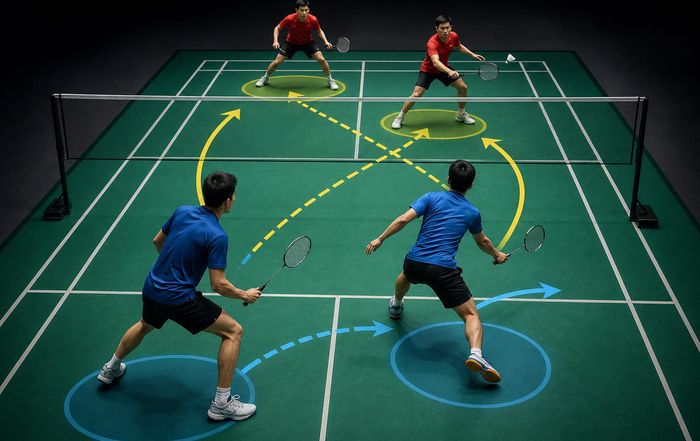
Badminton Doubles Strategy: Mastering Rotations and Court Positioning
Doubles badminton at any serious level is won less by spectacular smashes than by what happens just before and just after those big shots: how partners move, rotate, and occupy space. At club level and even in many competitive leagues, the biggest gap between pairs is not power or fitness but how well they understand rotations and court positioning under pressure. This article breaks down how strong pairs structure their movement, how roles change from attack to defense, and how to train these patterns so they become automatic.
Why Positioning Matters More Than Power in Doubles
In singles, a player can sometimes get away with being slightly out of position if they have exceptional speed or racket skills. In doubles, the shuttle travels faster, rallies are shorter, and gaps appear immediately when one player drifts out of place. Modern elite pairs tracked by bodies like the Badminton World Federation (BWF) routinely hit smashes over 300 km/h, but what separates the world's best is how they create those smashes and then maintain pressure through coordinated positioning.
Good doubles positioning does three things simultaneously. First, it shrinks the court for opponents by taking away easy angles and forcing them to hit into your strengths. Second, it reduces the physical load on each partner because they know which zones they are responsible for rather than chasing everything. Third, it makes your own attack more efficient, because the front player can anticipate weak replies and the rear player can commit fully to big attacking shots. For players who are already comfortable with basic strokes and want to raise their level, learning structured positioning and rotations is often the fastest way to improve match results.
For readers who also train other sports, the logic is similar to defensive rotations in basketball or coordinated pressing in football: one person out of position forces everyone else to compensate, and the whole structure collapses. On the badminton side, understanding these patterns also connects naturally with broader topics like training, performance, and fitness, because the more efficient your movement, the longer you can sustain a high-intensity style of play.
The Three Core Formations: Attack, Defense, and Neutral
At its simplest, doubles positioning revolves around three main formations: front-back (attacking), side-side (defensive), and a looser neutral shape used in transition. Strong pairs move fluidly between these structures depending on who has the initiative in the rally.
In attack, the classic front-back formation puts one player in the rear court, usually around the rear tramlines, and one player in the forecourt, roughly between the service line and mid-court. The rear player focuses on smashes, steep drops, and half smashes; the front player looks to intercept anything loose and kill it early. This split lets the rear player hit hard without worrying about short replies and lets the front player commit to cutting off flat or weak lifts. Watching top pairs in events like the All England Open or the Olympic Games (covered extensively by outlets such as Olympics.com and BBC Sport) makes this pattern very clear.
In defense, pairs usually shift to a side-side structure. Here both players stand a little behind the service line, roughly in line with each other, each covering their half of the court. The aim is to survive the opponent's attack, return the shuttle with enough height and length to escape pressure, and look for a chance to counterattack. The spacing between defenders is critical: too close and they leave both sidelines exposed; too far and they open a big gap down the middle.
Neutral situations arise on flat or ambiguous shots where neither side has a clear attacking advantage. This might happen after a flat drive exchange, a mid-court block, or a slightly short lift that is not easy to smash. In these moments, top pairs adopt a flexible stance that can quickly morph into front-back or side-side. Many club players lose points here by committing too early to an attacking shape when they are not truly in control, or by staying side-side when they could have seized the attack. Learning to recognize and respond to these "50-50" balls is a major step toward higher-level tactical play.
Front-Back Attack: Roles, Zones, and Smart Rotations
In a true attacking situation-usually after forcing a weak lift or a poor defensive clear-the ideal is a clear division of labor. The rear player's primary job is to maintain pressure with smashes, drops, and attacking clears, choosing targets that keep the shuttle away from the opponent's strongest defender or from their forehand side if they are particularly dangerous there. The front player's job is to own the net area, cutting off loose blocks, intercepting drives, and forcing the defense to lift again. This is where many rallies are effectively decided.
Within this formation, rotations happen naturally when the shuttle is played to one side or when the rear player moves forward after a drop. For example, if the rear player smashes crosscourt and is then pulled forward by a tight block, the front player often rotates back to cover the now-open rear court. High-level coaches and national associations such as Badminton England (badmintonengland.co.uk) and USA Badminton (usabadminton.org) emphasize drilling this pattern until it becomes instinctive: as soon as one partner moves significantly forward or sideways, the other compensates to keep the court balanced.
Shot selection is central to safe rotations. A rear player who smashes wide to the tramlines but does not recover quickly leaves a large diagonal gap if their partner has already shifted forward. Conversely, a front player who over-commits to one side of the net exposes their partner to straight counterattacks. The best pairs choose attacking lines that match their positioning: straight smashes when the front player is strong on that side, or body smashes when the defense looks unstable. For readers interested in the physical side of maintaining this style, resources on fitness and conditioning and performance are particularly relevant, because repeated explosive jumps from the rear court demand strong legs and core.
One subtle but important element is depth. The rear player should not stand too far back; being a step inside the rear line improves reach for drops and half-smashes and makes it easier to move forward on short replies. The front player, meanwhile, should be just close enough to threaten the net but not so tight that they cannot move back for a quick drive or lift. International coaching resources from organizations like Badminton Europe (badmintoneurope.com) often highlight this "elastic distance" between partners as a hallmark of advanced doubles.
Side-Side Defense: Staying Compact Without Becoming Passive
When facing a strong smash, the priority shifts from attacking to surviving while looking for a chance to turn the tables. In a solid side-side defense, each player typically stands slightly behind the service line, knees bent, racket up, with their non-racket leg slightly forward for stability. The distance between players should be close enough that they can each reach the middle without leaving the tramlines unguarded. Good pairs communicate clearly about who takes which middle shuttles, often deciding that the backhand side defender or the stronger smasher will take more of the central shots.
Effective defensive positioning is not just about surviving; it is about neutralizing the attack and creating opportunities. Many national teams, including powerhouses like China and Indonesia, train defenders to vary their returns: sometimes lifting high and deep to reset, sometimes driving flat to surprise, and sometimes blocking softly to the net to tempt the attackers into moving forward and losing their rear-court presence. Once the attackers are forced into a weaker position-for example, hitting a soft drop from too far back-the defending pair can step forward and transition into front-back themselves.
One common mistake at club level is drifting too far back in defense, especially when facing very hard smashes. This gives more reaction time but also opens the front court, making it easy for opponents to use soft drops and net shots. Another error is standing too upright, which slows lateral movement. Leading sports science institutions such as Sports Authority of India (sportsauthorityofindia.nic.in) and high-performance centers in Denmark and Japan have long stressed low, balanced defensive stances to allow quick pushes off either leg.
Defensive communication is just as important as structure. Simple cues like "mine," "yours," or calling "switch" when one player is dragged too far out of position can prevent collisions and confusion. Pairs who also play together in club leagues or local tournaments may build routines around this, including specific signals for who will take smashes aimed at the middle. For athletes interested in mental aspects and teamwork, the broader themes fit naturally with lifestyle and social dimensions of sport, where trust and communication can be as important as physical skills.
Neutral and Transitional Phases: The Hidden Battleground
Many rallies are decided not in clearly attacking or defensive moments, but in the transitional exchanges that link them. Flat drives, mid-court pushes, and half-lifts are all examples of shots where neither pair has a clear advantage yet. How a pair positions themselves in these moments often decides who gets the next full attack.
In these phases, top pairs stay slightly staggered rather than perfectly side-side or front-back. For instance, after a flat drive exchange, one player may stand a step closer to the net, ready to pounce on any weak reply, while the partner stays slightly deeper and more central to cover lifts and body shots. This shape allows quick shifts into full attack if a chance arises: a slightly shorter lift, a mistimed drive, or a net shot that sits up. Analysts from outlets such as Badminton World TV and major sports media like ESPN often highlight how fast world-class pairs recognize and exploit these half-chances.
Rotations in neutral phases are more subtle. Instead of big switches from front to back, players make micro-adjustments: a step forward here, a shuffle sideways there, always trying to keep the shuttle in front of them and to avoid both players moving in the same direction at once. A useful rule of thumb is that when one player moves aggressively to attack the shuttle, the partner should move in the opposite direction or adjust depth to maintain balance. For example, if one player steps forward aggressively to intercept a drive, the partner may take half a step back and toward the middle to cover any counter-drive past them.
Another key element is recognizing when not to force the attack. Many pairs at intermediate level try to smash or rush every slightly high shuttle, only to get counterattacked because they were not truly in a strong attacking shape. Elite pairs, by contrast, are comfortable staying in neutral exchanges until they can create a clearer opening. This patience is tactical, not passive: they keep the shuttle flat, vary angles, and probe for weaknesses while maintaining a structure that can quickly convert to front-back when the time is right.
Mixed Doubles vs. Level Doubles: Strategic Differences in Positioning
While the fundamental formations are similar, mixed doubles and level (same-gender) doubles use rotations and positioning differently because of traditional role splits and the way most pairs exploit physical strengths. In mixed doubles, the standard model places the woman closer to the net and the man more often in the rear court, especially in attack. This is not a rule, but it reflects how many elite mixed pairs maximize their combined strengths, as seen in major events documented by organizations such as Badminton Asia (badmintonasia.org) and Badminton Oceania (badmintonoceania.org).
In mixed attack, the front-back structure is even more pronounced: the front player aggressively guards the net, seeking to intercept any weak blocks or drives, while the rear player does much of the heavy attacking work. Rotations still happen-for example, if the rear player is pulled forward by a short net shot-but many pairs try to restore the preferred alignment quickly, with the stronger rear-court player moving back whenever possible. This can lead to more complex footwork patterns and requires clear communication so that both players know when to "rebuild" their standard formation.
In level doubles, roles are typically more fluid. Both players are expected to attack from the rear and intercept at the net, and rotations are more frequent and symmetrical. When one player smashes and then moves forward after a drop, the partner naturally rotates back, regardless of gender. As a result, training for level doubles often emphasizes versatility, with both athletes practicing rear-court power and front-court speed. National team programs in countries like Denmark, Japan, and Indonesia, highlighted by federations and media such as Yonex and Li-Ning, frequently develop players who can excel in both roles.
For club players who participate in both mixed and level doubles, understanding these differences helps avoid confusion. It is useful to discuss before a match how aggressively each partner wants to play at the net, who will usually take the rear court, and how quickly you will rotate back to your preferred pattern after being forced out of it. These pre-match agreements can prevent in-game hesitation and miscommunication.
Common Positioning Mistakes and How to Fix Them
Across club and league play, certain positioning errors appear again and again. Recognizing these patterns can help players self-diagnose and adjust. One of the most frequent issues is both partners drifting toward the shuttle, especially on mid-court shots. When both players move to the same side, they leave the opposite side or the middle exposed, and experienced opponents will exploit this immediately. A simple fix is to mentally assign "lead" and "support" roles in each rally phase: the player closest to the shuttle is the lead; the partner automatically becomes support and moves to cover the opposite space.
Another common mistake is failing to transition from defense to attack after forcing a weak lift. Many pairs successfully block or drive their way out of trouble but then stay side-side instead of letting one partner step forward to attack. Working on this "defense to attack" switch is crucial. As soon as you see a lift that is not deep enough, one player should call "mine" and move back to smash, while the partner moves forward to take the net. This is a moment where structured training drills can make a big difference.
Players also often stand too static at the net, especially when they are unsure whether a lift will come. Good net positioning involves constant small adjustments: split steps, tiny shuffles, and a ready racket position. If the front player is too passive, the rear player must work harder, and the pair loses many chances to finish rallies early. Resources on movement quality and health can help here, since joint mobility and leg strength influence how comfortable players feel in a low, active stance.
Finally, some pairs over-rotate, switching positions on almost every shot. While rotations are essential, unnecessary switching creates confusion and opens gaps. A useful guideline is that rotations should be triggered by clear events: a big movement forward by one player, a deep shot that drags someone into a new zone, or a tactical decision to change who is attacking from the rear. Avoid rotating just because both players happened to take one or two shots in a row from different sides.
Practical Drills to Internalize Rotations and Positioning
Understanding positioning intellectually is only the first step; making it automatic requires targeted practice. Many national federations and coaching bodies, including Badminton Canada (badminton.ca) and Badminton Australia (badminton.org.au), publish guidance emphasizing structured doubles drills that repeat specific movement patterns.
A simple but powerful exercise is the "front-back rotation drill." One feeder stands on the opposite side and alternates between lifting to the rear and playing soft blocks or pushes to the net. The attacking pair starts in front-back formation. When the feeder lifts, the rear player smashes or drops; when the feeder blocks, the rear player moves forward to retrieve and the front player rotates back. The goal is to complete long sequences of smooth, error-free rotations without verbal communication, letting the movement pattern become instinctive.
Another useful drill is the "defense to attack transition." Here, the feeder smashes repeatedly while the pair defends side-side, returning with blocks and drives. After several shots, the feeder deliberately plays a shorter or weaker smash that can be lifted more aggressively. The pair must recognize this chance, lift deep to a corner, and then immediately shift into front-back, with one player moving back to attack. This trains the habit of seizing transitional opportunities rather than staying in a purely defensive mindset.
For club players without a coach, filming practice sessions or matches can be invaluable. Watching footage later often reveals positioning gaps that are hard to feel in real time. Combining this with general resources on sports performance and world badminton coverage, such as matches streamed by BWF or covered by Eurosport, can provide visual models to emulate.
Integrating Strategy with Fitness, Communication, and Mindset
Effective doubles positioning does not exist in isolation; it is tied to physical conditioning, communication habits, and mental approach. Physically, playing an aggressive front-back style requires repeated sprints, lunges, and jumps. Incorporating strength and conditioning work inspired by organizations like the American College of Sports Medicine (acsm.org) or national sports institutes can help players sustain high-intensity patterns without breaking down late in games. Strong legs and a stable core make rotations faster and safer, reducing the risk of injury when changing direction.
Communication is the glue that holds rotations together under pressure. Simple conventions-who calls "out," how you signal serves, who usually takes the middle-should be agreed before stepping on court. During play, clear, early calls ("mine," "yours," "switch," "leave") prevent hesitation. Many successful pairs also debrief briefly between rallies, using a few words to reset: "You stay front this time," or "Watch their cross drop." These habits align closely with themes in social dynamics in sport, where mutual trust and shared language are essential.
Mentally, good positioning demands discipline. It is tempting to chase every shuttle, especially when adrenaline is high, but strong pairs trust their structure and accept that some shuttles are not theirs to take. They also stay patient in neutral rallies, resisting the urge to go for low-percentage winners from poor positions. Following international coverage from sources like The Guardian or The New York Times on major tournaments often reveals how top players talk about "sticking to the game plan" and "trusting the partnership," both of which are rooted in positioning discipline.
For active readers who combine badminton with other pursuits, this integrated approach-technical, physical, and psychological-fits naturally into a broader active lifestyle. Doubles strategy becomes not just a set of court movements but part of a larger toolkit for playing smarter, moving efficiently, and collaborating effectively under pressure.
Bringing It All Together on Court
The essence of strong doubles strategy lies in understanding where the shuttle is, who has the initiative, and how two players can cover the court more effectively together than either could alone. Front-back attack, side-side defense, and flexible neutral shapes are not rigid diagrams but living structures that change with every shot. Rotations are simply the adjustments that keep those structures intact as both partners move.
For players looking to improve, the most practical steps are clear. First, watch high-level doubles-through platforms supported by the BWF, major broadcasters like BBC Sport, or regional confederations-and pay attention specifically to how pairs move, not just how they hit. Second, build simple, focused drills into your practice to rehearse front-back rotations, defense-to-attack transitions, and neutral positioning. Third, talk with your partner before and after matches about roles, preferences, and communication cues.
Over time, these patterns will become instinctive. When that happens, rallies feel smoother, gaps disappear, and attacking opportunities seem to appear more often. Power and shot quality still matter, but they are amplified by smart movement. For active athletes who enjoy both the tactical and physical side of sport, mastering rotations and court positioning in badminton doubles is one of the most satisfying ways to elevate the game.