

Swimming Stroke Efficiency: Common Mistakes and How to Fix Them
Efficient swimming is less about brute strength and more about how you move through the water. Whether someone is training for a triathlon, chasing a personal best in the pool, or simply trying to make laps feel less exhausting, stroke efficiency is usually the biggest lever they can pull. Across all four competitive strokes-freestyle, backstroke, breaststroke, and butterfly-many athletes repeat the same technical errors that waste energy and slow progress. Understanding those patterns, and knowing how to correct them, can transform both performance and enjoyment in the water.
This wet guide brings together insights from swim coaching practice, biomechanics research, and elite technique models to highlight the most common efficiency-killing mistakes and practical solutions. It focuses primarily on pool strokes, but most concepts apply equally to open-water swimmers and fitness-focused lap swimmers.
Why Stroke Efficiency Matters More Than Fitness Alone
In water, drag increases sharply with speed, so small technical flaws have outsized effects. Studies from organizations such as World Aquatics and academic sports science labs have repeatedly shown that improving technique can reduce energy cost per meter more than simply increasing aerobic capacity. In practical terms, a swimmer who tightens their streamline, times their kick better, and maintains a stable body position will often outpace a fitter but less efficient rival over most distances.
Efficiency matters differently depending on the discipline. Pool sprinters push the limits of power and speed, but even they rely on creating propulsion with minimal wasted motion. Distance swimmers and triathletes, by contrast, are most constrained by energy conservation; for them, technical improvements can mean holding race pace with a lower heart rate and less muscular fatigue. Recreational swimmers chasing health and longevity gains-topics closely tied to fitness and health-benefit too: better technique reduces shoulder and lower-back stress, decreases injury risk, and makes sessions feel smoother and more meditative rather than like a constant struggle.
From a coaching perspective, efficiency is also more "portable" than fitness. Aerobic conditioning drops quickly when training volume falls, but once ingrained, efficient movement patterns tend to persist. That's why national governing bodies such as USA Swimming and Swim England emphasize technical development in youth programs long before heavy mileage or strength work. For adult swimmers, the same logic applies: time invested in drilling core skills like balance, timing, and streamlined posture pays off across every session, stroke, and distance.
Body Position and Streamline: The Foundation Most Swimmers Skip
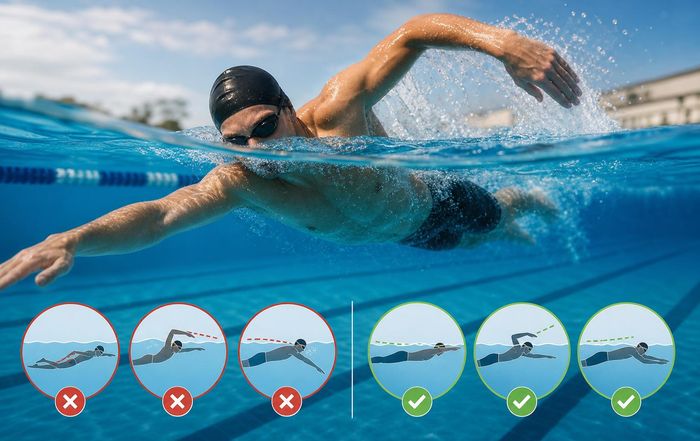
One of the most widespread issues across all levels is poor body position. A high, horizontal body line is the foundation for every stroke, yet many swimmers allow their hips and legs to sink, increasing frontal drag. In freestyle and backstroke, this often stems from lifting the head to breathe or look forward, arching through the lower back, and letting the core "switch off." In breaststroke and butterfly, the problem is often excessive vertical movement-riding too high on the breath and then dropping too deep between strokes-creating a rollercoaster path instead of a relatively flat, forward-focused line.
The technical solution begins with awareness. Coaches frequently use kickboard-free balance drills, such as kicking on the side with one arm extended, to teach swimmers to align head, spine, and hips. The goal is a neutral head position: eyes looking slightly down in freestyle, straight up in backstroke, and forward-and-down in butterfly and breaststroke, with the waterline around the crown of the head rather than the forehead. Engaging the core-lightly bracing the abdominal and glute muscles-helps keep the hips near the surface. Swimmers can also practice full-streamline push-offs from the wall, focusing on squeezing the ears with the arms and elongating the body, then trying to carry that feeling into each stroke.
From a performance standpoint, governing bodies and high-performance centers such as the Australian Institute of Sport and British Swimming have repeatedly highlighted streamline improvements as "low-hanging fruit" that can cut significant time over a race. Simply holding a tight, extended position off each wall and minimizing unnecessary movements during the stroke can improve lap times without any additional fitness. For athletes cross-training from other sports covered in our performance and training coverage-such as runners and cyclists-this emphasis on posture and alignment will feel familiar; the difference is that in water, misalignment is punished much more harshly.
Freestyle: Breathing, Catch, and Kicking Errors That Drain Speed
Freestyle is the primary stroke for triathletes, open-water swimmers, and many fitness swimmers, so inefficiencies here have an outsized impact. One of the most common issues is poor breathing mechanics. Many swimmers lift their head forward or twist excessively to breathe, which drops the hips and breaks the body line. Others hold their breath underwater and exhale only when turning to breathe, leading to air hunger and rushed inhalations. Both patterns increase tension and disrupt rhythm.
Technique models from organizations like USA Swimming and educational platforms such as Swim Smooth emphasize continuous, relaxed exhalation into the water followed by a quick, calm inhalation with minimal head rotation-just enough for one goggle to clear the surface. Drills like side-kicking with a snorkel or single-arm freestyle can help swimmers feel the correct alignment and timing. Bilateral breathing (every three strokes) is not mandatory for racing, but practicing it in training often improves symmetry and reduces over-rotation to one side.
Another major efficiency leak in freestyle is an ineffective catch and pull. Many swimmers drop their elbows, press down instead of back, or start the pull too wide, all of which reduce propulsion and strain the shoulders. High-level technique emphasizes an "early vertical forearm," where the fingertips and forearm angle downward while the elbow stays high, allowing the swimmer to press water backward rather than downward. Research shared by World Aquatics and sports biomechanics labs suggests that this pattern improves propulsion per stroke and can reduce shoulder loading when executed correctly. Paddles, pull buoys, and sculling drills are commonly used tools, but they must be applied carefully to avoid reinforcing poor mechanics.
Kicking is another area where many freestyle swimmers lose efficiency. Sprinters may benefit from a strong six-beat kick, but distance swimmers and triathletes often need only a compact, steady kick that supports body position and rhythm. Overkicking with bent knees, kicking from the knees instead of the hips, or letting the feet drop too deep all increase drag. Short, narrow kicks with relaxed ankles and minimal knee bend are usually more efficient. Fins can be useful for training, but as FINA (now World Aquatics) and many national bodies note, they should complement, not replace, unassisted kicking to avoid overreliance.
Backstroke: Alignment, Rotation, and Hand Entry Problems
Backstroke shares many mechanics with freestyle but flips the swimmer onto their back, which introduces its own efficiency pitfalls. A common problem is "sitting" in the water: the hips sink while the head is pushed too far forward, causing a curved spine and extra drag. Some swimmers also let their knees break the surface dramatically on the kick, which wastes energy and destabilizes the body. A neutral head position-eyes up, chin slightly tucked, with the waterline around the ears-combined with a gentle core brace usually helps lift the hips and flatten the body line.
Rotation is another key factor. Efficient backstroke involves controlled body roll around the longitudinal axis, allowing the shoulder to clear the water and setting up a strong catch. Many swimmers either stay too flat, which limits reach and power, or over-rotate, which delays the next stroke and can lead to crossing the arms over the midline. Technique programs from organizations like Swim England and Swimming Canada stress rhythmical rotation driven from the hips and core rather than just the shoulders. Drills such as double-arm backstroke or 6-kick-switch (rotating after several kicks on each side) can enhance awareness of timing and body roll.
Hand entry and pull path are also frequent trouble spots. Some swimmers enter thumb-first with a straight arm, which can stress the shoulder joint and direct the hand too far across the body. Others push water sideways instead of backward, wasting propulsion. A more efficient pattern involves entering with the little finger first, arm nearly straight but relaxed, then bending the elbow underwater to create an effective catch. The hand should trace a path that stays roughly in line with the shoulder, pressing water toward the feet. Strength and mobility work on land, a theme we often explore in fitness and lifestyle coverage, can support this by improving shoulder stability and thoracic mobility.
Breaststroke: Timing, Glide, and Leg Mechanics
Breaststroke is technically demanding and unforgiving of timing errors. One of the biggest efficiency killers is performing the arm pull, breath, and kick as separate, disjointed actions instead of a coordinated sequence. Many swimmers pull too wide and too far back, lift the head excessively to breathe, then delay the kick or snap it too quickly, causing the body to surge upward and then stall. This stop-start pattern dramatically increases energy cost and slows forward momentum.
Elite models, highlighted by national programs such as Swim Ireland and USOPC coaching resources, describe breaststroke as a cycle of "pull-breathe-kick-glide." The arms initiate a narrow, powerful scoop that brings the body forward and slightly up for the breath, followed quickly by the kick that drives the body into a streamlined glide. The head returns to a neutral, down-facing position before the kick finishes, helping maintain a flatter body line. Shorter, more frequent strokes with a clear glide phase are often faster and more efficient than big, dramatic pulls and kicks that cause excessive vertical movement.
Leg mechanics are another major source of inefficiency. Many swimmers perform a "bicycle" or flutter-like kick instead of a true breaststroke whip or frog kick. Others allow the knees to flare too wide, increasing drag and stressing the knees and hips. A correct breaststroke kick involves drawing the heels toward the hips with the knees no wider than shoulder-width, turning the feet outward, then sweeping the lower legs and feet in a circular, whipping motion to meet behind the body. Dryland mobility work for the hips and ankles, along with targeted kick drills using a board or on the back, can help ingrain this pattern. Sports medicine organizations such as the American Physical Therapy Association and NCAA Sport Science Institute have also highlighted the importance of balanced hip strength to reduce the risk of "breaststroker's knee," underlining the connection between technique, efficiency, and injury prevention.
Butterfly: Rhythm, Undulation, and Overpowering the Stroke
Butterfly has a reputation as the most demanding stroke, and for many swimmers, inefficiency here is obvious: they feel like they are fighting the water. A common mistake is trying to muscle through each stroke with the arms while neglecting the body's undulating motion and the contribution of the legs. This often leads to a choppy, up-and-down pattern where the swimmer spends too much time with the head and shoulders above water and not enough time in a streamlined, forward-driving position.
High-level butterfly technique, as demonstrated by programs like Swimming Australia and analyzed by performance centers such as the US Olympic & Paralympic Committee, is built around rhythm and body wave. The chest presses slightly downward as the arms enter and extend forward, the hips rise, and then the body undulates forward as the arms pull and the legs kick. Most swimmers benefit from a two-beat kick per stroke cycle: one kick during the catch and pull, and another as the arms recover over the water. When the timing is right, the stroke feels smoother and less exhausting, even at higher speeds.
Another efficiency issue is overreaching or recovering the arms too wide and straight, which strains the shoulders and slows the stroke rate. A more relaxed, slightly bent-arm recovery close to the surface generally reduces load and helps maintain rhythm. Many coaches use drills such as single-arm butterfly, body-dolphin with arms at the side, or "3-3-3" (three strokes of butterfly, three of freestyle) to help swimmers learn the correct body movement without being overwhelmed by full-stroke intensity. As with other strokes, targeted strength and mobility work-especially for the shoulders, spine, and hips-supports better technique and reduces injury risk, an area increasingly discussed in sports science and health research.
Cross-Stroke Mistakes: Overtraining, Neglecting Mobility, and Ignoring Feedback
Beyond stroke-specific errors, there are broader habits that undermine efficiency in every style. One is simply doing too much mindless volume without technical focus. Many adult swimmers log lap after lap at a comfortable pace but rarely challenge their movement patterns. Without deliberate practice-drills, speed changes, video review-bad habits become ingrained. Sports science organizations such as World Aquatics, the American College of Sports Medicine, and Sport England consistently emphasize that quality of training often matters more than quantity, especially for skill-based movements like swimming.
Another cross-stroke issue is neglecting mobility and strength imbalances. Tight shoulders, stiff ankles, and weak core muscles all make it harder to achieve and maintain efficient positions in the water. Research from institutions like Mayo Clinic and Harvard Health has linked targeted strength and flexibility programs to reduced overuse injuries and improved athletic performance. For swimmers, this might mean incorporating shoulder external-rotation work, thoracic spine mobility drills, hip stability exercises, and ankle flexibility work into weekly routines. These are themes that intersect strongly with broader fitness and training habits across many sports.
A third, often overlooked factor is the lack of objective feedback. Unlike running or cycling, where pace and power are easy to track, swimming makes it harder for athletes to sense small technical changes. Without video, stroke counting, or occasional coaching input, many swimmers remain unaware of how they actually move. National federations and clubs increasingly use underwater cameras, tempo trainers, and stroke-rate monitoring to give athletes clear data and visuals. Recreational swimmers can benefit from simpler tools: asking a coach or experienced swimmer to film short clips, counting strokes per length, or using a waterproof metronome to explore different stroke rates and find a more efficient rhythm.
Finally, context matters. Open-water swimmers and triathletes must adapt efficiency principles to choppy conditions, sighting for buoys, and crowded starts, while pool swimmers contend with turns, underwater phases, and race-specific pacing. Yet the underlying ideas-streamlined body position, effective catch, well-timed breathing, and balanced effort-remain constant. For those interested in the broader culture and technology around the sport, including innovations in wearables and training tools, our technology and sports sections often explore how data and equipment shape technique-focused training.
Putting It Together: Building a More Efficient Stroke
Improving stroke efficiency is rarely about a single dramatic change. It is usually a process of identifying one or two key weaknesses, addressing them with targeted drills and awareness, and then reassessing. Many successful swimmers and coaches follow a simple progression: stabilize body position and streamline; refine breathing and head position; improve catch and pull mechanics; then fine-tune timing, rhythm, and race-specific details. Along the way, they balance pool work with sensible strength and mobility training and use feedback tools to ensure that changes in feel correspond to actual improvements in speed and ease.
For athletes at every level, the most productive mindset is to treat efficiency as a long-term skill rather than a quick fix. The water is an unforgiving but honest environment: it rewards precise, economical movement and punishes waste. Swimmers who are willing to slow down, pay attention, and experiment with technique often find that speed and endurance follow naturally. Those improvements also tend to make time in the pool more enjoyable, which, in turn, supports consistency-the real driver of progress in any endurance sport.
Pool lovers who want to explore how swimming fits into an active lifestyle can find related media in our updated pages on fitness, training, sports, performance, and lifestyle. Whether the goal is a faster 100 meters, a smoother first triathlon, or simply more relaxed and efficient laps, the path runs through the same principles: better body position, smarter mechanics, and a patient, technically focused approach to every stroke.