

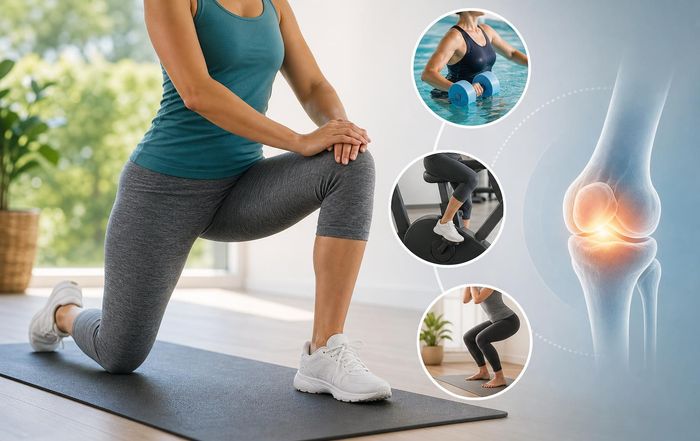
Low-Impact Exercises to Strengthen Your Knees
Protecting your knees is less about avoiding movement and more about choosing the right kind. Whether you are a runner trying to stay injury-free, a lifter looking to support heavy squats, or simply want pain-free stairs and daily life, targeted low-impact exercise can be one of the most effective ways to build stronger, more resilient knees.
This guide explains how to strengthen the muscles that support the knee joint, which movements to prioritize, how to progress safely, and when to seek expert help. It is not a substitute for medical advice, but it can help you have a more informed conversation with a doctor, physiotherapist, or coach.
How the Knee Works - And Why "Low-Impact" Matters
The knee is a hinge joint formed by the femur (thigh bone), tibia (shin bone), and patella (kneecap), stabilized by ligaments (ACL, PCL, MCL, LCL), menisci, and a network of muscles and tendons. The key muscles that protect your knees include the quadriceps on the front of the thigh, hamstrings on the back, gluteal muscles around the hips, and calf muscles below the knee. When these muscles are strong and coordinated, they absorb and distribute forces that would otherwise stress the joint surfaces and ligaments. High-impact activities like jumping and hard running surfaces increase loading rates through the knee, which can aggravate conditions such as patellofemoral pain, tendinopathies, or osteoarthritis. Low-impact training, on the other hand, keeps overall joint stress manageable while still providing enough load to build strength and improve function.
Organizations such as the American Academy of Orthopaedic Surgeons and Arthritis Foundation emphasize that avoiding movement entirely often worsens knee problems over time by weakening muscles and reducing joint nutrition, because cartilage relies on regular movement and load to stay healthy. The goal is not to eliminate load, but to dose it intelligently. Low-impact exercises-where at least one foot usually stays on the ground or the body is supported by water, a bike, or a machine-are ideal for this. Before starting a new program, especially if you have a history of knee surgery, significant swelling, or locking, a consultation with a healthcare professional, such as a physiotherapist or sports medicine doctor, is strongly recommended.
Principles of Safe Knee Strengthening
A smart knee-strengthening plan is built on a few key principles that apply whether you are an elite athlete or returning from a long break. First, pain should guide-but not completely dictate-your training. Mild discomfort around the knee (often described as a 0-3 out of 10) that does not worsen during or after the session is usually acceptable, particularly in chronic conditions, but sharp, catching, or escalating pain is a red flag to stop and reassess. Second, progression should be gradual. Increasing load, volume, or complexity too quickly is a common reason knee-friendly exercises become knee-irritating. Many clinicians suggest changing only one variable at a time-repetitions, sets, resistance, or frequency-by roughly 5-10 percent per week.
Third, form matters as much as exercise selection. Poor alignment-such as knees collapsing inward during squats or lunges-can increase stress on the patellofemoral joint and ligaments. Using mirrors, filming your technique, or working with a qualified coach can help. Fourth, consistency beats intensity. Two or three sessions per week of targeted work often outperform occasional "hero" workouts. Finally, low-impact strengthening must be integrated with broader habits: body weight management, overall activity level, and recovery practices. Resources from organizations like the American College of Sports Medicine and World Health Organization stress that adults benefit from at least 150 minutes of moderate-intensity aerobic activity per week plus muscle-strengthening on two or more days; knee-friendly choices make those targets more realistic for many people.
For readers looking to build a broader routine around these principles, the training-focused content on training and performance can help translate guidelines into weekly plans.
Foundational Low-Impact Strength Exercises
These exercises focus on the muscles that most directly support the knee and can usually be performed with minimal equipment. If you have current pain, it is often wise to start with easier, more supported versions before progressing.
1. Straight-Leg Raises
Straight-leg raises are often used in early rehabilitation because they activate the quadriceps without much bending at the knee. Lying on your back with one leg straight and the other bent, you tighten the thigh muscle of the straight leg and slowly lift it to about the height of the opposite knee, then lower under control. The emphasis should be on a strong quadriceps contraction and slow tempo rather than height. This move helps re-engage the quadriceps, especially the vastus medialis oblique (VMO) near the inner knee, which plays a role in patellar tracking.
To progress, you can add a small ankle weight, increase repetitions, or perform the exercise in a seated position, which changes the angle of load. If the front of the hip becomes more fatigued than the thigh, it may indicate that the hip flexors are compensating, and you might need to reduce range of motion or adjust your pelvic position. While simple, this exercise is often a useful building block before moving into weight-bearing moves like squats or step-ups. For more on how targeted strength work intersects with general fitness, readers can explore broader conditioning strategies that complement joint-specific work.
2. Wall Sits
Wall sits are an isometric exercise, meaning the muscles work without visible joint movement. Standing with your back against a wall and feet slightly forward, you slide down until your knees are bent roughly 45-60 degrees (a shallower angle is usually more joint-friendly than a deep 90-degree position for those with anterior knee pain). You then hold this position for 20-45 seconds, focusing on even weight distribution through the feet and relaxed upper body. Wall sits can build endurance in the quadriceps, which is important for activities such as walking downhill or prolonged standing.
As tolerance improves, you can increase the hold time, add sets, or hold a weight close to your chest. If you feel pressure under the kneecap, try a higher position (less bend) or adjust your foot distance from the wall. Research summarized by groups such as Physiopedia and clinical guidelines from NHS services suggest that isometrics can reduce pain in some knee conditions, particularly patellar tendinopathy, when used alongside progressive strengthening.
3. Glute Bridges
Although the glutes sit above the knee, their strength and control profoundly affect knee mechanics. Weak gluteus medius and maximus muscles are associated with increased knee valgus (inward collapse) during running, landing, and squatting. Glute bridges are a low-impact way to target these muscles. Lying on your back with knees bent and feet hip-width apart, you press through your heels to lift your hips until your body forms a straight line from shoulders to knees, then lower slowly. The focus is on squeezing the glutes rather than arching the lower back.
Progressions include single-leg bridges, placing feet on an elevated surface, or adding resistance with a band around the thighs to challenge hip abduction. Ensuring the knees remain aligned with the toes during the movement trains the hip muscles to stabilize the leg in a functional position. Integrating glute work into a comprehensive program can be particularly valuable for runners and field-sport athletes; readers interested in the broader performance implications can explore sports coverage that often touches on lower-limb mechanics and injury trends.
Knee-Friendly Squat and Hinge Variations
Squats and hip hinges are fundamental patterns for daily life-sitting, standing, lifting, and jumping all rely on them. Many people with knee discomfort assume squats are off-limits, but the issue is usually how they are performed rather than the movement itself. Low-impact, controlled versions can build strength and confidence without excessive load.
One of the most accessible variations is the sit-to-stand. Using a chair or bench, you sit down under control and stand back up, using minimal assistance from the hands. Adjusting seat height allows you to tailor difficulty: higher seats are easier and less demanding on the knees, while lower seats increase range of motion and muscular demand. Emphasizing a hip-back movement (as though reaching for the chair with your hips) and keeping knees aligned over the middle of the foot helps distribute load between hips and knees. For many, this pattern is a bridge to bodyweight squats without external support.
For those ready to progress, shallow bodyweight squats with a comfortable depth can be introduced, followed by variations such as goblet squats holding a light weight. Hip-dominant hinges like Romanian deadlifts with light dumbbells or kettlebells load the posterior chain-hamstrings and glutes-while keeping the knee relatively stable and minimally flexed. This shift toward the hip joints can be more tolerable for people with anterior knee pain. Educational resources from organizations like Examine and Mayo Clinic often highlight the importance of these compound patterns for long-term joint function and independence, especially in aging populations.
Step-Ups, Lunges, and Balance Work
Once basic strength and control are established, step-based movements help prepare the knees for real-world tasks like climbing stairs, hiking, and changing direction in sport. Step-ups are generally more knee-friendly than deep lunges because you can control height and direction of load. Starting with a low step or sturdy platform, you place one foot on the step, press through the heel to stand up, then lower slowly. Keeping the knee tracking over the second or third toe and avoiding inward collapse is key. Over time, step height, load, and speed can be increased.
Lunges introduce more challenge, and not everyone's knees tolerate them well initially. Reverse lunges (stepping backward rather than forward) often feel better because they reduce the braking forces on the front knee. Shorter step lengths and shallower ranges can further reduce stress. Split squats, with feet fixed in a staggered stance, let you focus on vertical movement and alignment without the added complexity of stepping. If pain appears at the front of the knee, experimenting with torso angle (slightly more forward lean), stride length, or reducing depth can help, but persistent discomfort warrants professional assessment.
Balance and proprioception work-such as single-leg stands, using a cushion or balance pad, or gentle lateral movements-train the neuromuscular system that stabilizes the knee during unpredictable tasks. Athletes in sports that involve cutting or jumping, such as football or basketball, often include such drills in their programs to reduce injury risk. Readers interested in how professional teams integrate these elements into daily practice can find broader coverage in training and world sections that examine global trends in sports preparation.
Low-Impact Cardio Options That Support Knee Health
Strength work is only part of the equation. Low-impact cardiovascular exercise improves blood flow, helps manage body weight, and supports joint nutrition without the higher impact forces of running or jumping. For many with knee sensitivities, cycling, swimming, and elliptical training are mainstays.
Cycling, whether on a stationary bike or outdoors, allows continuous movement through a controlled range of motion. Adjusting saddle height so that the knee retains a slight bend at the bottom of the pedal stroke reduces stress. Overly low saddle positions can increase compressive forces around the patella. Indoor cycling also lets users manipulate resistance and cadence to balance cardiovascular and muscular demand. Guidance from organizations such as British Cycling and USA Cycling often emphasizes fit and technique to prevent overuse issues.
Swimming and deep-water running are even more joint-friendly because buoyancy offloads body weight. Freestyle and backstroke are usually better tolerated than breaststroke for many people with knee problems, as the whip kick can stress the medial structures. Aquatic therapy programs, supported by groups like the Aquatic Exercise Association, are commonly recommended for those with osteoarthritis or recovering from surgery. Elliptical machines and low-impact cross trainers provide a hybrid between cycling and walking, with a smooth, gliding motion that limits impact yet still challenges the cardiovascular system.
For readers looking to integrate these options into a broader active lifestyle, the health and lifestyle sections offer context on how different movement choices interact with sleep, stress, and nutrition to influence overall well-being.
Mobility, Flexibility, and Recovery for Happier Knees
Strength alone is not enough; the tissues around the knee also need appropriate mobility and recovery. Limited ankle dorsiflexion, for example, can force the knee to compensate during squats and landing, while tight quadriceps or hip flexors can increase pressure on the patella. Gentle stretching of the quadriceps, hamstrings, calves, and hip flexors can improve comfort and movement quality, especially when combined with active mobility drills such as controlled leg swings, knee-to-wall ankle mobilizations, and hip circles.
Recovery practices such as adequate sleep, nutrition that supports tissue repair, and sensible training schedules are also essential. Chronic knee pain often reflects an imbalance between load and capacity-doing more than the joint and its supporting structures are currently prepared to handle. Monitoring weekly training volume, using pain and fatigue as feedback, and scheduling lighter days can help avoid flare-ups. Resources from institutions like Harvard Health Publishing and Cleveland Clinic frequently highlight the role of body weight in knee load, noting that each extra kilogram of body weight can translate into several kilograms of force across the knee during walking. This does not mean weight loss is a simple or sole solution, but it underscores why nutrition, metabolic health, and joint care are interconnected.
Self-management strategies-such as occasional use of ice after a new or intense session, compression sleeves for proprioceptive feedback, or short-term anti-inflammatory medication under medical guidance-can all play a role. However, ongoing reliance on painkillers to "push through" knee pain is usually a sign that training needs to be adjusted, not just masked. For those interested in how active lifestyles intersect with broader health issues, the health and environment sections often explore the wider context of movement, urban design, and access to safe exercise spaces.
When to Seek Professional Help
Low-impact exercises are generally safe, but there are situations where self-guided programs are not enough. Red flags that should prompt medical assessment include significant swelling that appears quickly after an injury, the knee giving way or locking, inability to fully straighten or bend the knee, or pain that persists or worsens despite several weeks of appropriately modified exercise. A sports medicine physician, physiotherapist, or orthopedic specialist can help identify structural issues such as meniscal tears, ligament injuries, or advanced osteoarthritis.
Professional assessment may involve physical examination, imaging, and functional testing to pinpoint contributing factors, which often include hip and ankle mechanics, movement patterns, and training history. Evidence-based treatment plans from organizations like the American Academy of Orthopaedic Surgeons, National Health Service in the UK, and American Physical Therapy Association typically combine targeted exercise, education, and sometimes short-term adjuncts like bracing or taping, with surgery reserved for specific indications. Online resources from reputable bodies such as OrthoInfo (via AAOS), NHS, and major hospital systems like Mayo Clinic or Johns Hopkins Medicine can help you understand diagnoses and options, but they should complement, not replace, in-person evaluation.
For athletes and highly active people, integrating medical guidance with performance goals can be complex. Coverage in sports and business often shows how professional organizations manage player health, workload, and return-to-play decisions-approaches that can offer useful principles even for recreational athletes.
Building a Sustainable, Knee-Friendly Routine
The most effective low-impact knee program is one you can maintain over months and years, not just a few motivated weeks. A practical framework for many adults might include two or three weekly sessions of targeted strength work (e.g., straight-leg raises, wall sits, glute bridges, sit-to-stands, and step-ups), alongside two or more sessions of low-impact cardio such as cycling, swimming, or elliptical training. Within that structure, exercises can be rotated and progressed to maintain interest and challenge. Tracking small wins-such as holding a wall sit longer, stepping onto a higher platform, or walking farther without discomfort-can be motivating markers of progress.
It is also important to recognize that knee health sits within a broader picture that includes work patterns, footwear, playing surfaces, and even social factors such as access to safe facilities and supportive communities. Readers interested in how sport, technology, and culture intersect around issues like injury prevention and active living can explore technology, culture, and social coverage, where topics like wearable tracking, digital coaching platforms, and community sport initiatives are frequently discussed. By combining informed exercise choices with a realistic, sustainable routine and, when needed, expert guidance, most people can significantly improve knee strength, comfort, and confidence-keeping them active in the sports and everyday activities they value.