

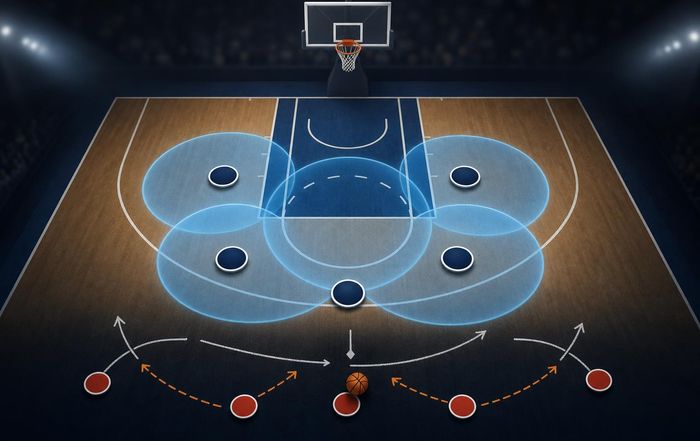
Basketball Zone Defense: Formations and Strategies Explained
Zone defense has always sat at the intersection of tactics, philosophy, and rulebook in basketball. From high school gyms to EuroLeague arenas and FIBA competitions, it is a staple. In the NBA, it was once heavily restricted and is now fully legal again, changing how coaches think about space, help, and matchups. For players and coaches at any level, understanding how zone defenses work-why certain formations are used, how they're beaten, and how they evolve during a game-is central to building a modern defensive identity.
This guide breaks down the major zone formations, the principles that make them effective, and the strategies that both defenders and offenses use in this ongoing tactical chess match.
What makes a zone defense different?
In a man-to-man defense, each defender is primarily responsible for a specific opponent, following them through cuts, screens, and drives. In a zone, defenders are responsible for areas of the floor, not individual players. Assignments shift as the ball moves, and matchups are more fluid: a wing might guard three different players on one possession, all while never leaving their designated zone.
Coaches gravitate toward zone defenses for several reasons. They can protect weaker individual defenders, keep bigs closer to the rim to reduce fouls, and clog driving lanes against explosive guards. Zones can also disrupt rhythm offenses that rely on isolation or pick-and-roll mismatches. At youth and high school levels, where skill ranges are wide, zones often compensate for teams that lack size or footspeed, while at elite levels they are used more selectively as change-ups or end-game tactics.
The flip side is that zones can be vulnerable to good shooting, patient ball movement, and smart high-post play. They demand high communication and discipline; when one player is late on a rotation, a zone can collapse quickly. Governing bodies like FIBA and the NCAA allow zones freely, while the NBA now permits them but retains defensive three-seconds rules to prevent pure "camping" in the paint, shaping how pro coaches deploy zone concepts. Official rules from organizations such as FIBA, the NBA, and the NCAA are useful references for understanding these structural differences.
For players, learning zone concepts complements individual defensive skills and can significantly improve overall team performance-something that ties directly into broader themes of training, performance, and tactical understanding.
Core principles that all effective zones share
Regardless of formation, strong zone defenses tend to follow a few shared principles.
First, they are ball-oriented. The defense shifts as a unit toward the ball side, shrinking space where the offense is most dangerous. This "tilt" must be balanced with protection of weak-side areas, especially the opposite corner and the backside rebounding lane. Good zones look like a living organism: they compress and expand with the ball, rather than five statues guarding fixed spots.
Second, communication is non-negotiable. Defenders constantly call out cutters, screens, and switches: "high post," "corner," "skip," "baseline," and similar cues. Without this, gaps appear between zones, and offenses quickly exploit them. Many coaches train this communication the same way they train conditioning-repetitively and with clear standards-linking tactical work with broader fitness and mental habits.
Third, line integrity matters. Zones are built in horizontal and vertical lines-top line, wings, back line. When one defender over-extends or chases a fake, the line behind or beside them must "bump" and fill, or the shell breaks. This is especially visible in 2-3 and 3-2 zones, where wings often pass players off to corners or high posts.
Fourth, rebounding and transition are deliberately planned. A common criticism of zones is that it's harder to box out without a clear man. Effective teams pre-assign rebounding responsibilities by zone area and stress "hit-and-go-get" principles: find the nearest body, make contact, then pursue the ball. Since many modern offenses push pace, zone teams also drill how they flow from zone coverage into fast-break lanes, integrating defensive schemes with broader transition and tempo philosophies.
Finally, disguise and flexibility separate basic zones from advanced systems. Some teams "show" zone for a few seconds before matching up, or they blend zone with man principles (matchup zones). Others switch between 2-3 and 1-3-1 after free throws or timeouts. At higher levels, this constant shifting can turn defense into a psychological weapon, affecting offensive decision-making and even the cultural identity of a team's style of play, something often explored in broader sports culture discussions.
The 2-3 zone: Protecting the paint
The 2-3 zone is the most recognizable formation in basketball: two guards across the top, three players forming a back line along the lane. It's widely used in high school and college basketball and is associated with programs like Syracuse, whose long-time coach Jim Boeheim built a reputation for his particular brand of 2-3. Historical and tactical overviews from outlets such as ESPN and The Athletic have frequently analyzed how this system shaped entire eras of college play.
In a classic 2-3, the two top defenders are responsible for the ball at the perimeter, especially at the top and on the wings. They must contain dribble penetration, contest threes, and funnel ball handlers toward help. The three back-line players protect the paint, defend the short corners and low blocks, and step up to challenge mid-range shots. The middle defender (often a center) anchors the rim and contests anyone entering the lane.
The strengths of the 2-3 are clear. It packs the paint, making it difficult for opponents to get layups or post touches. It can hide slower guards and protect bigs from constant isolation attacks. It also tends to generate deflections when long-armed wings are active in passing lanes, which can lead to transition opportunities and fast-break scoring. Teams with size and length across positions, including many European clubs highlighted by EuroLeague, often weaponize this formation.
However, the 2-3 has inherent vulnerabilities. The corners and high post are natural soft spots, and modern offenses frequently attack it with shooters spaced in both corners and a skilled passer or scorer at the free-throw line. Skip passes over the top stress the weak-side wing, who must cover a long distance to contest. If the top guards are passive or the back line is slow to "bump" out, the result can be a barrage of uncontested threes.
Coaches adapt the 2-3 in several ways: extending the top two defenders to nearly half-court to disrupt early offense, having wings aggressively close out to corners while the back-line center shifts side to side, or morphing the 2-3 into a matchup zone where defenders pick up nearby players once they enter a zone. These variations demand high conditioning and clear roles, aligning with the broader emphasis on defensive systems within team performance and training programs.
The 3-2 and 1-2-2 zones: Guarding the perimeter
As three-point shooting has become central to modern basketball, coaches have increasingly turned to 3-2 and 1-2-2 zones to prioritize the arc. Both formations place three defenders across the top line, but their responsibilities and emphases differ slightly.
In a 3-2 zone, three players form a line across the perimeter-usually two wings and a middle guard-while two players protect the back line. This setup naturally covers the wings and top of the key, making catch-and-shoot threes more difficult. It is particularly useful against teams that run their offense through wing actions, flare screens, and quick ball reversals for shooters. The back two defenders must communicate constantly to track cutters, protect the rim, and close out to corners when the ball swings.
The 1-2-2 zone looks similar but shifts the emphasis slightly. One defender (often a quick guard) pressures the ball high, sometimes even in the backcourt, while two defenders sit behind them around the free-throw line extended, and two more anchor the baseline. This shape is popular as a press-back alignment: teams might show a 1-2-2 full-court press, then fall back into a half-court 1-2-2 or 3-2 look. Resources from coaching bodies like USA Basketball and federations such as Basketball England often present these as flexible tools for youth and senior teams alike.
The primary advantage of these perimeter-oriented zones is obvious: they run shooters off the line and disrupt rhythm jumpers. They can also generate turnovers via aggressive closeouts and traps near the sideline or corners, feeding fast-break opportunities. But they can be vulnerable to attacks in the high post and short corners, where the offense can overload the two-man back line. A skilled high-post player can catch, face, and either shoot from mid-range or hit cutters diving behind the defense.
To mitigate this, coaches teach "triangle" or "box" help concepts within the zone. When the ball enters the high post, the nearest three defenders collapse into a triangle around the ball while still reading kick-outs. The back line must be prepared to rotate quickly if the ball is skipped to the opposite corner. As with all zones, the system is only as strong as the communication and anticipation of the players executing it.
The 1-3-1 zone: Traps, chaos, and sideline pressure
The 1-3-1 zone is one of the most distinctive and aggressive zone formations. One defender pressures the ball at the top, three stretch across the middle of the floor, and one roams the baseline. It is often associated with trapping, deflections, and a high-risk, high-reward style that can change the tempo of a game in a few possessions.
In a classic 1-3-1, the top defender forces the ball to one side, where the wing and top defender can trap along the sideline near half-court or near the hash marks. The middle line (two wings and a central player) must have length and activity, getting hands into passing lanes and discouraging direct passes to the high post. The baseline defender, often a long and mobile forward, is responsible for both corners and the rim, sprinting from side to side as the ball moves.
The strengths are pronounced when executed well. The 1-3-1 can generate steals, rushed decisions, and broken offensive spacing. It is particularly effective against teams that lack confident ball handlers or struggle with cross-court passing. At youth and high school levels, where handling pressure is still developing, this defense can transform games. Internationally, some clubs and national teams have used 1-3-1 variants as occasional "shock" defenses, as covered in tactical features from outlets like FIBA's own coaching resources and analysis from sites such as Coaching Toolbox.
But the risks are equally clear. The corners and opposite wing are inherently exposed if rotations are late. Good passing teams can find open threes or layups behind the back line by reversing the ball quickly or flashing a skilled high-post facilitator. Rebounding can also be problematic, as the shape of the defense often leaves players covering space rather than a body when the shot goes up.
Coaches who favor the 1-3-1 often emphasize length, conditioning, and a "playmaker mentality" on defense. Players are encouraged to gamble within structure, go for deflections, and treat defense as a chance to create offense. This approach ties into broader discussions about team identity, culture, and how a club's style of play can shape its brand and appeal, themes that surface frequently in sports business and culture coverage.
Matchup zones and hybrid systems
Beyond the classic formations, many modern teams use matchup zones and hybrid systems that blur the line between zone and man-to-man. In a matchup zone, defenders start in a zone alignment but quickly "match up" with offensive players entering their areas, switching and handing off assignments as the ball moves. The result can look like man-to-man on film, but with underlying zone rules governing help and positioning.
These systems are attractive because they can protect weaker defenders and maintain strong help principles, while still allowing tight coverage on shooters. For example, a team might play a 2-3 shell but have wings stay glued to elite corner shooters, effectively turning portions of the court into man coverage. Others will call "switch to man" on certain triggers, such as a ball reversal or the shot clock reaching a specific time.
Hybrid approaches also include schemes like box-and-one and triangle-and-two, where part of the team plays zone while one or two defenders face-guard star scorers. These tactics have appeared at all levels, from youth tournaments to international competitions covered by outlets like BBC Sport and CBS Sports, especially when underdogs try to neutralize a single dominant opponent.
The complexity of matchup zones demands high basketball IQ. Players must understand both man and zone concepts, recognize screening actions, and communicate constantly. For coaches, this often means investing significant practice time and film study, linking tactical sophistication with mental preparation and even broader performance psychology, areas increasingly explored in health and mental performance coverage.
How offenses attack zone defenses
To understand zone defense fully, it helps to view it from the offense's perspective. Effective offenses rarely just pass around the perimeter and take contested jumpers. Instead, they use specific principles and actions to stress the weak points of each formation.
The high post is a central weapon against almost any zone. Placing a skilled passer or shooter around the free-throw line forces the defense to decide: collapse and risk kick-outs, or stay home and allow a high-percentage mid-range look or dump-offs to cutters. Many coaches teach an "inside-out versus zone" philosophy: get touches in the high post or short corner, then play out of those advantages.
Overloads and ball reversals are another staple. Against a 2-3, for instance, an offense might put three players on one side (corner, wing, high post), forcing the zone to shift and stretch. Quick reversals or skip passes then find open shooters as defenders scramble back. Analytical work from sites like Basketball Reference and broader coverage from Sports Illustrated have highlighted how the rise of three-point shooting and spacing has made these concepts even more potent.
Offenses also use screening actions to distort zone shape. Ball screens at the top of a 2-3, flare screens for shooters on the weak side of a 3-2, and baseline screens to free corner shooters against a 1-3-1 all force zones to communicate and adjust. Cutters who move purposefully-flashing from corner to short corner, or from wing to high post-can occupy multiple defenders at once, creating temporary 2-on-1 situations elsewhere.
Finally, tempo and transition are critical. Some teams push the ball quickly to attack zones before they are fully set, seeking early post seals or quick threes. Others slow the pace deliberately, probing for breakdowns and forcing zone defenders to sustain concentration for long stretches. This tug-of-war over tempo connects defensive schemes directly with broader strategic questions about pace, conditioning, and style of play that sit at the heart of modern basketball analysis.
Teaching and training zone defense effectively
For coaches and players, implementing a zone is not just about drawing Xs and Os on a whiteboard. It requires structured teaching, thoughtful practice design, and an understanding of how tactical work fits into overall athletic development.
Many coaches begin with shell drills, where players walk through rotations at low speed, learning how far to slide, when to bump, and how to adjust as the ball moves around the perimeter. Over time, they add live reads: cutters, ball screens, and skip passes. Emphasis is placed on stance, hand activity, and closeout technique-core defensive skills that also benefit man-to-man schemes and align with general training principles for agility and footwork.
Video analysis is another powerful tool. Film from professional leagues such as the NBA or EuroLeague, as well as international competitions under FIBA, can illustrate how elite teams adjust their zones in real time. Coaches may clip sequences showing proper rotations, successful traps, or breakdowns leading to open shots, using them as teaching moments.
Conditioning and communication drills are integrated into these sessions. For example, coaches might run "continuous closeout" drills where players sprint from zone spots to contest shooters, then immediately recover to new positions. Others demand constant verbal cues during scrimmages, penalizing silent possessions. This links tactical learning with broader fitness and performance goals, reinforcing that great defense is as much about effort and concentration as it is about scheme.
At advanced levels, sports science and analytics increasingly inform these choices. Teams may track defensive efficiency in different zone formations, evaluate which lineups work best in which schemes, or use player-tracking data to measure how far defenders move within a zone. While not every program has access to top-tier analytics, even basic stats-opponent three-point percentage versus zone, points per possession allowed, turnover rates-can guide decisions and align with the growing intersection of sport and technology.
When should a team use zone defense?
Deciding when to use zone is as strategic as choosing which formation to run. Coaches weigh personnel, opponent strengths, game context, and even broader cultural preferences about how their teams should play.
Teams often turn to zone when they are undersized or dealing with foul trouble. Packing the paint can compensate for a lack of individual rim protectors and reduce the number of direct isolation drives. Zones are also useful as change-ups: switching from man to zone after timeouts or made free throws can disrupt an opponent's rhythm or delay their set calls.
Matchups matter. Against opponents who lack reliable outside shooting, a 2-3 or 1-3-1 can dare them to win from the perimeter. Against teams with limited ball handling, pressure zones like a 1-2-2 or extended 3-2 can generate turnovers. Conversely, many coaches avoid zone against disciplined, well-spaced offenses with multiple shooters and a strong high-post presence.
Psychological factors also play a role. Zones can slow games down, cool off hot scorers, or force star players to give up the ball. They can also serve as a statement of identity-some programs are known for their zone as part of their brand, influencing how they recruit and how fans perceive their style. This connects defensive tactics with the broader ecosystem of sports culture, business, and identity.
Ultimately, the best coaches treat zone defense as a tool, not a crutch. It works best when integrated into a complete defensive philosophy that includes man-to-man fundamentals, clear communication standards, and a shared understanding of how defense fuels offense and shapes the flow of the game.
Bringing it together on the court
Zone defense is not a shortcut to winning; it is a different way of thinking about space, responsibility, and collective effort. Whether it's a 2-3 protecting the paint, a 3-2 chasing shooters off the line, a 1-3-1 hunting turnovers, or a nuanced matchup zone blending man and area principles, the effectiveness of any system depends on how well players understand and trust it.
For coaches and athletes looking to deepen their tactical toolkit, studying zone concepts can sharpen overall basketball IQ and complement individual skill development. Integrating these ideas into practice, film work, and broader performance planning can help teams at every level-from youth leagues to elite international competitions-defend more intelligently and play a more connected, modern game.
For readers interested in how defensive tactics intersect with broader themes like athletic performance, training methodology, and the evolving culture of basketball, exploring more daily stories across sports, performance, training, fitness, and health offers a richer picture of how strategy, science, and style continue to shape the sport.