

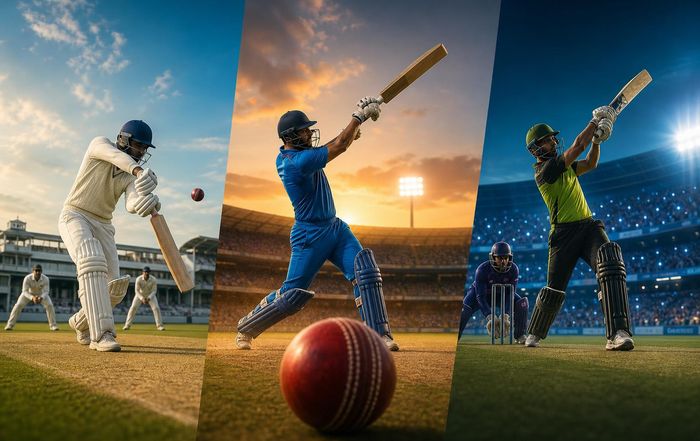
Cricket Formats Explained: Test, One-Day and T20 for Modern Fans
Cricket today is really three sports sharing one rulebook. The same players, the same basic laws, and the same pitch produce radically different spectacles when stretched over five days, squeezed into fifty overs, or crammed into a three-hour T20. For athletes, coaches, and fans who move easily between a morning run, an evening gym session, and a weekend match, understanding how these formats diverge helps make sense of tactics, fitness demands, and even the business of the global game. This guide breaks down Test, One-Day International (ODI), and Twenty20 (T20) cricket: how each works, how they evolved, what they demand from players, and how they shape the sport's future.
The shared core: what all formats have in common
Across Test, ODI, and T20, the foundations are identical. Two teams of eleven face off on a rectangular 22-yard pitch, with bowlers delivering an over of six legal balls and batters scoring in runs. Dismissals-bowled, caught, leg before wicket (LBW), run out, stumped and so on-are consistent, as are most fielding rules. The Marylebone Cricket Club (MCC) still maintains the global Laws of Cricket, while the International Cricket Council (ICC) oversees international competitions and format-specific playing conditions. Modern technology such as the Decision Review System (DRS), ball-tracking, and ultra-edge replays is now embedded across formats, changing how teams use tactics and time.
Yet once you overlay time limits and over restrictions, everything diverges. Strategy, selection, conditioning, and even national priorities can flip depending on whether a side is preparing for a five-day Test series, a World Cup in the 50-over format, or a high-intensity franchise T20 league. This is where cricket's "three sports" really begin.
For cricket lovers interested in how these tactical and physical demands intersect with training and performance, our sections on training and performance explore broader athletic principles that also apply beyond cricket.
Test cricket: the long game of skill, patience and endurance
Test cricket is the oldest and most traditional format, officially dating back to the 19th century. A Test match is scheduled over five days, with up to 90 overs bowled per day in international play. Each team has two innings to bat and bowl, and there is no fixed limit on the number of overs per innings. The match can end in a win, loss, draw, or tie, making it unique among major team sports in how it embraces the possibility of an honourable stalemate after days of battle.
Strategically, Test cricket is about resource management over time: bowlers must maintain intensity across spells and days; batters aim to occupy the crease for hours, sometimes scoring slowly to blunt an attack and wear down opponents. Captains juggle field settings, bowling changes, and declarations, betting on weather forecasts, pitch deterioration, and psychological pressure. Conditions evolve significantly: a fresh pitch on day one may favour batters, while by day four or five, cracks and footmarks can make spin and reverse swing decisive. This evolving environment rewards technical skill and mental resilience in ways shorter formats rarely can.
Physically, Test specialists often prioritise aerobic endurance, repeat-effort capacity, and robust recovery protocols. Fast bowlers may cover 20-25 kilometres of running in a match, with hundreds of high-impact deliveries stressing joints and soft tissue. Sports science teams-often drawing on research from institutions such as Loughborough University or Australian sports science programmes-manage workloads with GPS tracking, sleep monitoring, and carefully periodised training. For many players and purists, Test cricket remains the "ultimate test" because it exposes flaws over time: a slightly suspect technique, a wavering temperament, or poor conditioning is difficult to hide across five days.
Culturally, the format carries prestige. The ICC World Test Championship, launched to give Test cricket a clearer narrative, now culminates in a showpiece final. Traditional rivalries such as the Ashes between England and Australia, or India v Pakistan when political circumstances allow, still command huge audiences. Yet, the format faces challenges: long match durations, competing entertainment options, and the rise of T20 leagues have raised questions about commercial sustainability, especially in newer cricket markets.
One-Day Internationals: the 50-over middle ground
One-Day Internationals emerged in the 1970s as a shorter, more television-friendly alternative to Tests. Each team bats for a maximum of 50 overs, with a single innings per side. The side with the higher total wins, with ties and no-results possible when weather intervenes. Limited overs force teams to balance aggression and risk; there is no second innings to repair a collapse, but there is enough time that all-out slogging from ball one is rarely optimal.
The format's defining features include fielding restrictions, known as powerplays, and over limits per bowler-typically a maximum of 10 overs each in ODIs. These rules are designed to balance bat and ball, preventing teams from packing the boundary with fielders and forcing captains to use multiple bowlers. The modern ODI has been shaped by innovations such as coloured clothing, white balls, and day-night matches under floodlights, which helped attract new audiences once broadcasters like Channel 9 in Australia and later global networks invested heavily in the spectacle.
Tactically, ODIs are about tempo control. Teams often divide their innings into phases: cautious accumulation during the first powerplay while taking advantage of only two or three fielders outside the circle; consolidation through the middle overs; and an explosive "death overs" push. Data analytics, pioneered in cricket by analysts such as those behind the "Moneyball-style" revolution, now inform batting orders, match-up plans (for example, sending a left-hander to counter a particular off-spinner), and bowling changes. The role of all-rounders-players who contribute significantly with both bat and ball-is especially valuable in ODIs because they provide flexibility across these phases.
From a fitness perspective, ODI demands sit between Tests and T20s. Fielders cover substantial ground for around eight hours, but the intensity of sprint efforts is lower than in T20. Recovery between matches still matters, particularly in tournaments like the ICC Cricket World Cup, where teams can play multiple games in quick succession. Nutrition, hydration, and heat management-areas where organisations such as the World Health Organization (WHO) and national sports medicine bodies offer guidance-are crucial when events are staged in hot, humid climates.
Commercially, ODIs have long been a backbone of international cricket revenues thanks to World Cups, which remain among the sport's most watched events. The 50-over World Cup still carries enormous prestige for players and boards, though its position has been squeezed somewhat by the rapid rise of T20 franchise competitions.
T20 cricket: fast, loud and data-driven
Twenty20 cricket compresses a match into roughly three hours. Each team faces just 20 overs, and the format is built for prime-time television and packed stadiums. Rules are similar to ODIs-single innings, fielding restrictions, over limits per bowler (usually four)-but the short duration transforms behaviour. Batters attack from the outset, aiming for high strike rates; bowlers mix pace, variations, and angles to restrict scoring; fielding standards are exceptionally high, with diving stops, relay throws, and boundary acrobatics now expected rather than exceptional.
The launch of domestic T20 leagues, led by India's Indian Premier League (IPL) and followed by tournaments such as Australia's Big Bash League, England's The Hundred (a related but distinct 100-ball format), and leagues in Pakistan, the Caribbean, and elsewhere, has reshaped the sport's economy. Player auctions, franchise ownership, and global broadcasting deals have attracted investors and sponsors from sectors as varied as technology, finance, and entertainment. For many younger fans, T20 is their primary or even sole entry point into cricket, with music, fireworks, and social media content integrated into the live experience.
On the field, T20 is the most intensely tactical format. Teams rely heavily on analytics firms and in-house analysts, using ball-by-ball data to plan match-ups, preferred lengths, and field placements. Power-hitting coaches refine batters' bat swing mechanics and strength programmes, often drawing on methodologies familiar from baseball and golf. Bowlers develop specialised skills-slower balls, wide yorkers, back-of-the-hand deliveries, and defensive lines tailored to boundary dimensions. Even wicketkeepers and fielders train specifically for T20, focusing on explosive acceleration, lateral movement, and high-risk catching techniques.
The physical load in a single T20 is lower than in a Test, but the intensity is high, and franchise seasons can be congested. Strength and conditioning staff design programmes with a premium on sprint speed, power, and repeat high-intensity efforts, mirroring conditioning seen in other intermittent sports like football and basketball. Readers interested in how this compares with broader fitness trends can explore our fitness and lifestyle coverage, where high-intensity interval training and power development frequently feature.
How the formats shape skills and selection
Because the three formats reward different strengths, modern players and selectors increasingly talk about "red-ball" and "white-ball" specialists. Test cricket (red ball) emphasises patience, tight technique, and the ability to adapt to a deteriorating pitch. White-ball formats (ODIs and T20s) prioritise range hitting, innovation-such as reverse sweeps and ramps-and death bowling skills.
Some players excel across all formats, but that is becoming rarer as schedules intensify. National boards and franchises must decide how to manage workloads: whether to rest multi-format stars from bilateral ODI series, for example, to preserve them for marquee Test tours or high-value T20 leagues. Organisations such as Cricket Australia, the England and Wales Cricket Board (ECB), and the Board of Control for Cricket in India (BCCI) have all experimented with rotation policies and central contracts tailored to format priorities.
Selection strategies differ accordingly. In Tests, captains typically want at least three specialist fast bowlers, a frontline spinner, and batters capable of long innings. In ODIs, teams seek a deeper batting lineup, multiple all-rounders, and bowlers who can operate both with the new ball and at the death. In T20, line-ups may be stacked with power hitters and mystery spinners, with bowlers chosen as much for variety as for traditional skills. Franchise drafts and auctions, such as those run by the IPL and other leagues, have turned these skills into distinct market commodities, influencing how young players around the world train and specialise.
For athletes and coaches, this raises practical questions: should a young fast bowler focus on developing a strong red-ball action and stamina, or prioritise variations and yorkers for T20? Should a batter build a game around traditional defence first, or embrace power-hitting early? There is no single answer, but understanding the demands of each format helps shape more intentional career and training decisions, an issue we explore more broadly in our training and sports sections.
Fitness, workload and injury risk across formats
From a sports science perspective, the three formats present different risk profiles. Test cricket's long spells and cumulative workloads are associated with stress injuries, particularly for fast bowlers: lumbar stress fractures, knee issues, and soft-tissue strains. ODIs add significant fielding volume and repeated accelerations, while T20s concentrate high-intensity efforts-short sprints, dives, and explosive movements-into a compressed timeframe. Research published through bodies such as PubMed and guidance from organisations like FIFA's medical arm (though focused on football) have influenced how cricket boards monitor player load, cross-train, and manage return-to-play protocols.
Modern teams use GPS tracking, heart-rate monitoring, and wellness questionnaires to guide training loads between matches. Strength and conditioning programmes often include elements familiar to readers across other sports: resistance training for joint stability, sprint mechanics work, mobility and flexibility sessions, and structured recovery methods such as contrast baths and active recovery days. Nutrition strategies, informed in part by sports nutrition research from universities and institutes like Gatorade Sports Science Institute or Australian Institute of Sport, emphasise carbohydrate availability for long formats and adequate protein for recovery, alongside hydration and electrolyte balance in hot climates.
Injury prevention is not just a performance issue but also a business concern. With the growth of T20 leagues and year-round calendars, player unions and boards have become more vocal about burnout and mental health. Organisations such as the Federation of International Cricketers' Associations (FICA) advocate for clearer rest windows and workload management, underscoring how the three-format structure complicates player welfare.
Readers interested in broader health implications of high-level sport-including mental health, sleep, and long-term joint health-can find more context in our health and world sections, where we regularly connect elite sport science with everyday active lifestyles.
Money, media and the global balance of power
The coexistence of three formats is not just a sporting question; it is an economic and cultural one. Test cricket traditionally underpinned the sport's heritage, but it is expensive to stage and monetise over five days unless crowds and broadcast revenues are strong. ODIs, especially World Cups run by the ICC, remain lucrative and politically important, but bilateral ODI series have sometimes struggled for relevance. T20, by contrast, has attracted investment from broadcasters, sponsors, and private equity, with leagues like the IPL becoming major entertainment properties.
Media outlets such as ESPN, BBC Sport, and Sky Sports have adapted by offering format-specific coverage, while digital platforms and streaming services have created new ways to watch, analyse, and debate cricket in real time. Technology companies and social media platforms have also entered the ecosystem, with short-form highlights and data-driven graphics making T20 particularly shareable. This media environment tends to favour shorter formats, which fit more easily into global viewing habits and mobile consumption patterns.
At the governance level, the ICC and national boards must decide how to schedule and promote each format. Some countries, such as India and England, still invest heavily in Test cricket, maintaining strong domestic first-class structures. Others, particularly emerging markets, may lean more towards T20 because it is cheaper to stage, easier to sell, and more accessible for new fans. Debates about central calendars, windowed T20 leagues, and revenue-sharing reflect the tension between preserving cricket's traditional long form and capitalising on the commercial potential of its shortest.
These business dynamics intersect with broader questions about sport and society-labour rights, national identity, and the environmental impact of global travel-which we explore in more depth in our business, environment, and culture coverage.
Culture, identity and how fans experience each format
Beyond rules and economics, the three formats cultivate distinct cultures. Test cricket is often associated with tradition: whites, red balls, and long narratives that unfold over days. Fans who cherish it speak of the slow burn-sessions where "nothing happens" until suddenly everything does, the strategic battle between bat and ball, and the way conditions and psychology ebb and flow. Attending a Test can feel like a social ritual: office workers dropping in for a session, families making a day of it, radio commentary humming in the background.
ODIs occupy a middle ground culturally as well as structurally. One-day matches became the primary TV product during cricket's expansion in the late 20th century, and for many fans, iconic World Cup moments-Kapil Dev's India in 1983, Pakistan in 1992, Sri Lanka in 1996, Australia's dominant run in the 2000s-anchor their memories. The format's length allows for narratives and comebacks while still fitting into a single day, making it popular for weekend outings and national holidays.
T20, meanwhile, is often positioned as cricket's answer to modern entertainment: loud, colourful, and social media-ready. Night games, music, fan zones, and franchise identities attract younger audiences and families who might never attend a five-day Test. For some traditionalists, this feels like a departure; for others, it is a gateway that introduces new fans who may later explore longer formats. The coexistence of these cultures-heritage and innovation, patience and instant gratification-is part of what makes cricket's current era so distinctive.
Cricket's cultural impact also intersects with issues such as gender equity and inclusion. Women's cricket, supported by bodies like the ICC and national boards, has grown rapidly in the T20 and ODI formats, with events such as the Women's T20 World Cup and professional leagues expanding opportunities and visibility. The success of these shorter formats has, in turn, sparked renewed interest in developing women's Test cricket, showing how the formats can support rather than simply compete with one another.
Choosing your format: how to watch and what to look for
For readers new to cricket or those moving between formats, it can help to think in terms of what kind of sporting experience you want. If you enjoy long-form tactical battles similar to multi-day cycling tours or five-set tennis epics, Tests reward attention to detail: watch how bowlers set up a batter over several overs, how captains adjust fields ball by ball, and how batters construct innings session by session. If you prefer a full narrative in a single day, with room for shifts in momentum and strategic rebuilds, ODIs offer a satisfying arc. And if you want a fast, high-intensity event similar to an evening basketball game or football match, T20 delivers quick drama, innovation, and highlight-reel moments.
As you watch, notice how the same player adapts across formats. A batter might leave balls outside off stump in a Test, defend solidly, and only gradually expand their scoring options. In a T20, that same player could walk across the stumps to scoop a yorker over fine leg or clear the front leg to hit over long-on from the first over. A bowler who relentlessly hits a "good length" in Tests might rely more on slower-ball variations, wide lines, and yorkers in T20. These adaptations are at the heart of modern cricket's athletic and tactical complexity.
For those interested in the social side-how formats affect jobs in coaching, analytics, broadcasting, and sports tech-our jobs and technology sections regularly explore how the evolving cricket economy creates new roles and skill demands.
Where cricket's three-format future might be heading
Looking ahead, few expect cricket to revert to a single dominant format. Instead, the challenge is balancing three overlapping ecosystems: preserving Test cricket's depth and heritage, keeping ODIs meaningful beyond World Cups, and managing T20's explosive commercial growth. Administrators, players, and fans are still negotiating what that balance should look like: how many Tests can realistically be staged each year, whether bilateral ODIs need reshaping, and how to protect player welfare amid expanding T20 calendars.
At the same time, the three formats continue to cross-pollinate. Aggressive batting philosophies influenced by T20-often labelled with terms like "Bazball" in recent discourse-have changed how some teams approach Test cricket, leading to faster scoring rates and more results. ODI strategies have absorbed both Test-style patience and T20-style finishing, while T20 bowlers increasingly borrow red-ball skills such as control of seam and swing. For athletes and active fans alike, this convergence offers a richer, more varied sporting landscape.
Understanding the distinct demands and cultures of Test, ODI, and T20 cricket is not just a matter of trivia; it's a way to appreciate how one sport can encompass endurance and explosiveness, tradition and innovation, deep strategy and instant action. Whether you are streaming a late-night T20 league game, following a World Cup campaign, or dipping into a five-day epic on a radio app, recognising what each format asks of players-and offers to spectators-can make every over more engaging.