

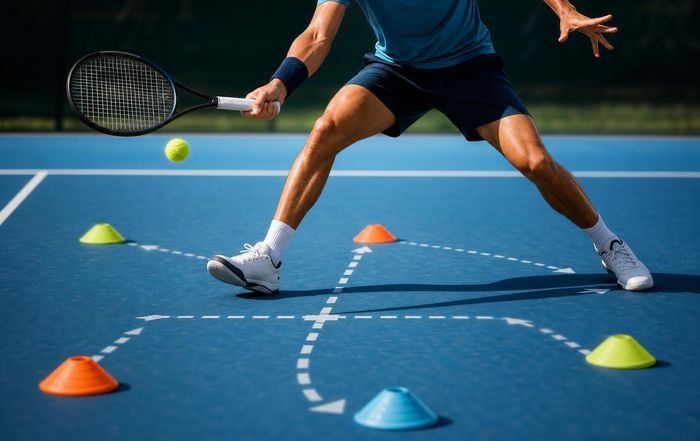
Tennis Footwork Drills for Better Balance and Court Coverage
Efficient footwork is the hidden engine of modern tennis. At every level-from local club leagues to ATP and WTA tours-players who move well arrive earlier to the ball, strike from stronger positions, and spend less energy over a match. For recreational and competitive athletes alike, targeted footwork drills can quickly improve balance, speed, and court coverage more than simply "playing more points." This article looks at why footwork matters so much, then breaks down practical drills you can plug into your next session, whether you train on hard court, clay, grass, or indoors. For tennis fans who already follow strength and conditioning advice, many of these drills connect directly to movement patterns covered in our broader training, fitness, and performance content. Integrating them smartly can turn generic "cardio" into tennis-specific athleticism.
Why Footwork Is a Skill, Not Just "Running Faster"
In tennis, footwork is less about straight-line speed and more about how quickly and efficiently a player can start, stop, change direction, and recover to a neutral position. Sports scientists talk about this as "change of direction speed" and "agility," which combine physical ability with decision-making. Research from organizations such as the International Tennis Federation (ITF) and USTA highlights that elite players take numerous short steps and use split steps and adjustment steps to manage balance on every shot, rather than relying on big lunges or desperate sprints. You can explore broader movement guidelines via the ITF and USTA.
Good footwork starts before the ball crosses the net. The split step-a small hop that lands as the opponent hits-preloads the muscles and lets the body explode in any direction. From there, cross-over steps, side shuffles, and small adjustment steps position the body behind the ball with weight forward and a stable base. This is as much a technique as a physical trait; players can be aerobically fit yet still move inefficiently if they don't train these patterns deliberately.
At the same time, footwork is tied to broader athletic qualities like lower-body strength, reactive power, and coordination. Organizations such as the American College of Sports Medicine and NSCA emphasize that multi-directional drills, plyometrics, and sport-specific agility work are crucial for court-sport athletes. Complementing on-court drills with off-court fitness and health routines can therefore make footwork training more effective and safer, especially for adult players returning from layoffs or managing high weekly volumes.
Foundational Movement: Split Step and First Step Acceleration
Before layering complex patterns, players need two base skills: a consistent split step and an explosive first step. These are the "serve and return" of movement-everything else builds on them.
A simple starting drill is the shadow split step. Stand on the baseline in ready position without a racket or with a light one. Have a partner call "hit" or clap randomly; each cue triggers a small split step, landing on the balls of the feet with knees slightly bent and weight balanced. Immediately after landing, take a quick first step in any direction-forward, backward, left, or right-then recover to center. If training solo, use a metronome app, a timer beep, or a ball machine's sound as your cue. This drill reinforces timing and teaches the body to react the moment the opponent makes contact.
To sharpen acceleration, progress to two-step bursts. From a split step, sprint two or three quick steps diagonally toward an imaginary ball (e.g., front-right forehand corner), plant, then shuffle back to the starting spot. Alternate directions, focusing on low, powerful pushes off the outside leg. Coaches sometimes use cones to mark short targets-around 3-4 meters away-to keep bursts game-realistic. Over time, players can chain several directions together (e.g., forehand corner, backhand corner, short ball) to mimic rallies.
Because these movements are repetitive and explosive, warming up carefully is essential. General guidelines from groups like the American College of Sports Medicine and Mayo Clinic emphasize dynamic warm-ups, progressive intensity, and awareness of joint stress. For players who also follow strength routines, integrating split-step and first-step work after a light warm-up but before heavy hitting can be ideal, as it trains speed when the legs are fresh.
Lateral Agility Drills for Stronger Baseline Movement
Most points at club and competitive level are decided in lateral exchanges along or behind the baseline. Training side-to-side movement therefore has a direct payoff in match play. The goal is not only to reach wide balls but to arrive balanced enough to hit with depth and then recover back toward the center.
A classic drill is the baseline shuffle. Place two cones or markers a few steps inside each singles sideline. Start from the center mark in ready position, perform a split step, then shuffle explosively to one cone, touch it with your hand or racket, and shuffle back through center to the opposite cone. Keep the hips low, chest up, and avoid crossing the feet; this encourages strong glute and hip engagement and reduces tripping risk. Coaches often run this drill in 15-30-second bursts to mimic rally durations, with equal rest to preserve movement quality.
For more tennis-specific rhythm, players can add shadow swings. Instead of touching the cone, they perform a full forehand or backhand swing at each edge, then shuffle back toward center. This connects footwork and stroke mechanics, encouraging the body to load on the outside leg, rotate through the shot, and then push off back toward neutral. Linking this with technical content on sports and training helps players see movement and stroke as a single system rather than isolated skills.
To challenge coordination, some coaches introduce lateral hop patterns using small hurdles or court lines. For example, players may hop sideways over a line on one leg, land softly, then transition immediately into a side shuffle. Guidance from organizations like NSCA and UK Coaching stresses that plyometric drills should be progressed gradually, especially for youth or older adults, to protect knees and ankles. Keeping volumes modest and focusing on soft, controlled landings can build lateral power without excessive impact.
Forward and Backward Movement: Approaches, Drop Shots, and Lobs
While lateral coverage is dominant, effective tennis footwork also requires confident movement forward for short balls and backward for lobs or deep drives. Many recreational players hesitate here, leading to off-balance shots or poor positioning at the net. Drills that target this "front-back" axis can transform how aggressively a player takes the ball.
A straightforward pattern is the V-drill. Place one cone on the baseline center mark and two cones a few meters inside the service line, one on each side. Start at the baseline cone, split step, and sprint diagonally forward to the left cone as if attacking a short ball. Perform a shadow approach shot, then shuffle or backpedal to the baseline cone. Immediately repeat to the right cone. This creates a V-shaped pattern that teaches players to move in on short balls and then recover quickly if the opponent passes or lobs.
For backward movement, the lob recovery drill is useful. Begin a few steps inside the baseline as if finishing an aggressive groundstroke. On a coach's signal, turn the shoulders and use a controlled crossover run or shuffle backward toward the baseline or beyond, simulating a retreat for a lob. The key is to avoid straight backpedaling at high speed, which can be risky for falls and knee injuries. Organizations like the International Tennis Federation and Physiopedia highlight safe movement mechanics, emphasizing turning the hips and shoulders to run, rather than leaning back.
Combining forward and backward movement with live feeds makes the drill more realistic. For example, a coach might feed a short ball to the forehand for an approach, followed by a lob, forcing the player to retreat and hit an overhead or defensive lob. This not only trains footwork but also decision-making under pressure-an area closely connected to mental and tactical themes explored in broader lifestyle and culture coverage of the sport.
Multi-Directional Cone Drills for Realistic Court Coverage
Tennis rarely asks players to move in simple straight lines. Instead, rallies demand complex, multi-directional patterns: diagonal sprints, lateral recoveries, and sudden stops. Cone-based drills can simulate these demands in a structured way, allowing players to rehearse movements that often decide points in real matches.
One versatile pattern is the star drill. Place one cone at the center mark on the baseline and four to six cones around it: one near each corner (deep forehand, deep backhand, forehand short angle, backhand short angle) and optionally one behind the baseline to simulate a deep defensive ball. Starting at center, the player split steps, then sprints or shuffles to a called cone, executes a shadow stroke, and recovers quickly to center. The coach or a training partner calls out random locations, forcing the athlete to react and change direction rapidly. Over time, adding a ball feed at each cone increases realism and forces players to hit while their heart rate is elevated.
Another useful pattern is the T-drill, widely used across court sports and documented by fitness resources such as Verywell Fit and Cleveland Clinic. In a tennis context, cones form a T: one at the base line center, one directly forward near the service line, and two at the ends of the service line. The player sprints forward from the base to the top of the T, shuffles sideways to each end, then shuffles back to the middle and backpedals or runs back to the start. This drill emphasizes acceleration, deceleration, and lateral movement under fatigue.
For players who like to track progress, timing these drills with a stopwatch or smartphone can provide objective feedback. Reducing completion time while maintaining clean footwork and posture indicates genuine improvement. It also helps athletes preparing for performance testing or competitive benchmarks, tying into broader performance and business themes around data-driven training in professional sport.
Ladder and Line Drills for Foot Speed and Coordination
Agility ladders and court lines are popular tools for developing quick feet and rhythm. While some coaches debate how directly ladder speed transfers to on-court performance, most agree that these drills improve coordination, ankle stiffness, and neuromuscular control, particularly for younger or less experienced athletes.
The two-in, two-out ladder drill is a staple. Facing forward, players step into each ladder square with both feet in sequence-right then left-then step out to the side with both feet before moving to the next square. The emphasis is on light, quick contacts on the balls of the feet, with minimal upper-body movement. Over time, players can add variations like lateral two-in, two-out, crossover steps, or backward patterns to challenge coordination. Resources from organizations like NIH and Harvard T.H. Chan School of Public Health note that such coordination work can be especially beneficial for injury prevention and lifelong motor skill development.
Court lines can substitute for ladders if equipment is limited. For example, a line hop series might have players perform quick side-to-side hops over a baseline or service line, then front-back hops, then diagonal patterns. Short work intervals (10-20 seconds) with full focus on technique and posture are more valuable than long, sloppy sets. Because line hops and ladder drills are relatively low-impact, they can also be integrated into warm-ups before heavier footwork or hitting.
However, it's important not to mistake ladder proficiency for complete tennis movement. These drills should support, not replace, more specific patterns like split steps, shuffles, and approach steps. Combining them intelligently with the sport-specific work described earlier aligns with broader fitness and training principles: build general qualities, then apply them in context.
Balance, Stability, and Injury-Smart Footwork
Better court coverage is only valuable if players stay healthy enough to use it. Tennis places significant stress on ankles, knees, hips, and the lower back, especially on hard courts. Incorporating balance and stability work into footwork training can improve performance while reducing injury risk, a priority echoed by health authorities such as the World Health Organization and NHS.
A simple but effective drill is the single-leg balance with rotation. Standing on one leg, the athlete maintains a slight knee bend and neutral spine while slowly rotating the upper body as if preparing for a forehand or backhand. Holding a racket or light medicine ball increases difficulty. This drill trains ankle and hip stability, which are critical when planting for wide balls or absorbing force during sudden stops.
Another option is the lunge and hold pattern. Players step into a forward or diagonal lunge, pause for two to three seconds while keeping the front knee aligned over the foot, and then push back to standing. Adding a shadow swing during the pause mimics the challenge of maintaining balance while striking. Clinically oriented resources like Hospital for Special Surgery and Cleveland Clinic often highlight controlled lunges and single-leg work as cornerstones of knee and hip resilience.
For athletes with a history of ankle sprains or knee pain, consulting a qualified medical or physiotherapy professional before intensifying footwork drills is wise. Tailored guidance can ensure that training supports long-term health rather than aggravating underlying issues. Even for healthy players, including a few minutes of balance and stability work two to three times per week can pay off in cleaner movement and more confident changes of direction.
Designing a Short, Effective Footwork Session
Many tennis players struggle to fit footwork training into already busy schedules of matches, lessons, and gym work. The good news is that even 15-25 focused minutes, two or three times per week, can make a visible difference in balance and coverage if structured well.
One practical template is to start with a general warm-up-light jogging, dynamic stretches, and a few easy shadow swings-then move into 5-8 minutes of ladder or line drills to "wake up" the feet. Next, spend 10-12 minutes on 2-3 higher-intensity court-specific patterns, such as the star drill, V-drill, and baseline shuffle, keeping work intervals short and sharp (15-30 seconds) with similar rest. Finish with a few minutes of single-leg balance and lunge-and-hold work to reinforce stability under fatigue. This structure aligns with broader conditioning concepts promoted by organizations like the Australian Institute of Sport and Sport England, which encourage short, high-quality, sport-specific sessions over indiscriminate volume.
For competitive players or those following periodized plans, footwork sessions can be adjusted across the week. Early in the week or training cycle, higher-intensity, more reactive drills can be emphasized, while on days closer to matches, players might choose lower-intensity coordination and balance work. Integrating these sessions with other elements like strength training, mobility, and tactical practice reflects the multi-dimensional nature of modern tennis, connecting not only to on-court sports performance but also to broader lifestyle choices around recovery, sleep, and stress.
Bringing It Onto the Match Court
Ultimately, the purpose of footwork drills is not to look sharp in practice but to feel calmer and more in control during real points. Players often notice that as their movement improves, they experience less panic when pulled wide, more time to prepare strokes, and better balance when changing direction. This can subtly shift match psychology: instead of fearing being "moved around," athletes start to welcome rallies that test their conditioning.
To transfer gains, it helps to consciously apply drill concepts during practice sets. For example, a player might focus on executing a clear split step on every opponent contact for one game, then emphasize rapid recovery steps to the center in the next, then work on confident forward movement for short balls in another. Over time, these focal points become automatic habits rather than conscious tasks. This kind of deliberate integration mirrors approaches used in high-performance environments documented by organizations like Olympic.org and Tennis Europe, where technical, physical, and tactical elements are always linked.
For athletes at any level, viewing footwork as a trainable skill-rather than a fixed trait-can be empowering. With a few strategically chosen drills, a modest time investment, and attention to balance and injury-smart progression, players can transform how they move, conserve energy, and control points. In a sport where the ball is only as good as the position you hit it from, that may be one of the most valuable upgrades available.