

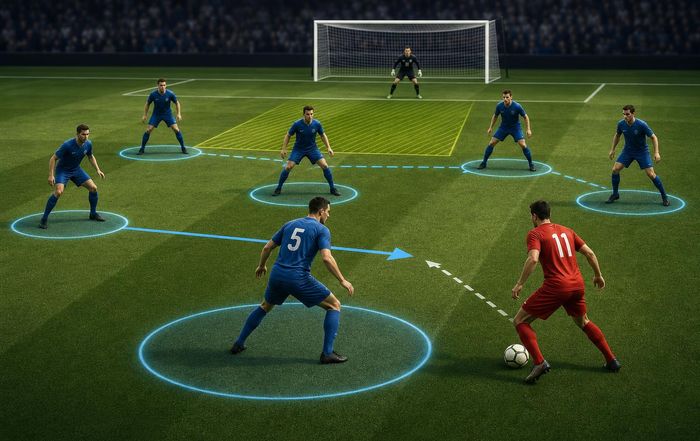
Soccer Defensive Positioning: A Practical Guide for Modern Players
Defensive positioning in soccer is often described as an art, but beneath that art is a very clear structure: angles, distances, body shape, and coordinated movement with teammates. At every level of the game, from youth leagues to elite professional teams, the difference between a solid defender and a truly reliable one usually comes down to positioning more than tackling ability or physical strength. This guide breaks down defensive positioning into practical concepts players can apply immediately, while connecting those ideas to how the modern game is actually played.
For footy readers interested in developing more top performance habits around defending, several of the ideas here also intersect with conditioning, decision-making, and communication covered across our training, performance, and sports coverage.
The Core Principles: Distance, Angle, and Body Shape
Strong defensive positioning starts before any tackle, interception, or header. Three concepts do most of the work: how far you are from the attacker (distance), where you stand relative to the ball, goal, and teammates (angle), and how you orient your body (body shape). Elite defenders and defensive coaches from clubs in the Premier League, La Liga, and Bundesliga consistently return to these basics, regardless of formation or style.
Distance is about managing risk. If you stand too close to a quick attacker, a simple feint or change of pace can beat you; too far, and they have time to shoot, pass, or dribble forward. Many professional coaches, including those influenced by the work of Pep Guardiola and Jürgen Klopp, emphasize "controlling" rather than "diving in." That usually means staying about an arm's length away when the attacker is facing you and has the ball under control, closing tighter only as you force them toward a less dangerous area or when support arrives. When the attacker is receiving a pass, defenders often step in more aggressively to intercept or challenge as the first touch is taken.
Angle is about showing the attacker into a direction that favors your team. Defenders rarely try to block every possible option; instead, they close one side and "invite" play into a safer channel. That might mean angling your run to push a right-footed winger toward the sideline, or shaping your body so the only easy passing lane is backward. Top national associations such as The FA in England and U.S. Soccer teach this concept from youth levels upward because it shapes how entire defensive units move together.
Body shape ties distance and angle together. Good defenders stay slightly side-on-knees bent, weight forward, hips open to both the ball and the space they want to guide the attacker into. This allows quicker lateral movement and a faster recovery if beaten. Turning square-on or flat-footed makes it easier for attackers to change direction past you. Sport science research published by organizations like FIFA and UEFA has increasingly highlighted how this low, side-on stance also reduces fouls in dangerous areas by giving defenders better balance and control when challenging for the ball.
Defending 1v1: Winning the Duel Before the Tackle
Most players think of 1v1 defending as a test of tackling. In reality, the duel is often won in the seconds before contact, through anticipation, timing, and subtle adjustments in position. In modern soccer, wide players and attacking midfielders are trained to exploit even small mistakes in a defender's stance or distance, making these details even more important.
The first priority in 1v1 situations is to slow the attacker down. As soon as the ball is played toward an opponent, defenders should close the space quickly, then decelerate early enough to avoid over-committing. Sprinting all the way to the attacker and stopping abruptly is a common mistake; it leaves defenders off-balance and easy to beat. Instead, coaches from leading clubs and national academies, including those referenced by UEFA and DFB (German FA), teach "fast to the ball, slow near the ball": accelerate to reduce space, then adopt a controlled, low stance a step or two away.
Once the attacker is under control, the defender's job is to guide, not gamble. Showing an attacker away from their stronger foot, toward the sideline, or into an area with more teammates is usually better than trying to win the ball immediately. Defenders should watch the attacker's hips and first touch rather than being drawn to step-overs or upper-body feints. The hips and first touch usually reveal the real direction of movement. When the attacker takes a heavy touch or turns their back to shield the ball, that is the cue to close in and challenge more aggressively.
In the penalty area, 1v1 defending becomes even more about discipline. Data from leagues analyzed by organizations such as StatsBomb and Opta shows how costly penalties and reckless challenges can be. Here, defenders should prioritize staying on their feet, using their body to block shots and passing lanes rather than reaching in. Hands should be kept down and away from the attacker's shoulders to avoid unnecessary fouls or VAR review. For players looking to integrate this into broader fitness and movement work, combining 1v1 drills with agility and deceleration training-something we often highlight in fitness coverage-can make these habits more automatic under fatigue.
Working as a Back Four or Back Three: Lines, Gaps, and Triggers
While individual defending matters, positioning in modern soccer is mostly a collective effort. Back fours and back threes operate as connected "lines" that slide, step, and drop together based on the ball's location and the opposition's movement. Watching elite teams in the UEFA Champions League or major international tournaments, defenders rarely act in isolation; their starting positions are dictated by the line's shape and by the midfielders in front of them.
The first concept is vertical compactness: the distance between the defensive line and the midfield line. Many professional coaches aim for roughly 10-20 meters between those units when the team is set in a mid-block. This reduces the space where creative attackers can receive the ball between the lines. If the back line drops too deep while midfielders stay high, gaps open for through balls and shots from the edge of the box; if the defense plays very high while midfielders don't press, long balls and runs in behind become a threat. Associations such as U.S. Soccer and The FA emphasize these distances in their coaching resources because they are a foundation for any defensive system.
Horizontally, defenders must manage the gaps between them-often referred to as "channels" or "seams." Center-backs should stay close enough that a single vertical pass cannot split them, while full-backs or wing-backs tuck in when the ball is on the far side to avoid leaving too much space between themselves and the nearest center-back. Many coaches use simple cues: if the ball is on your side, you can be wider to cover the winger; if the ball is far side, you come narrower, prioritizing central protection. This sliding movement is constant, not occasional, and demands communication.
Triggers dictate when the line steps up or drops. Common triggers to step up include a poor touch from an attacker, a backward pass under pressure, or a long aerial ball where the defender can win the header. Triggers to drop include a runner starting from deep, a midfielder facing forward with time, or a chipped ball into space behind the line. Successful defensive units agree on these cues in advance and rehearse them in training, rather than relying on improvisation. For players interested in the tactical side of the game, following analysis from outlets like The Coaches' Voice at thecoachesvoice.com or The Athletic at theathletic.com can provide examples of how top teams coordinate these movements.
Full-Back and Wing-Back Positioning: Balancing Width and Security
Full-backs and wing-backs have become some of the most tactically complex roles in modern soccer. In addition to defending wide areas, they are often asked to join attacks, underlap into midfield, or even invert into central zones. This evolution, seen in teams under coaches like Guardiola, Arteta, and Nagelsmann, makes defensive positioning more demanding, not less, for wide defenders.
Out of possession, the primary responsibility remains protecting the space between the touchline and the nearest center-back. When the ball is on their side, full-backs should position themselves slightly inside the opposing winger, not hugging the line. This inside-out positioning allows them to see both the winger and any central runners while also blocking the most direct route to goal. If they stand too wide, attackers can cut inside unopposed; too narrow, and a simple pass into the channel can release the winger behind them. National federations like DFB and KNVB (Dutch FA) often stress this "half-position" in their teaching materials.
When the ball is on the opposite side, full-backs should tuck in closer to the center-backs, forming a more compact back three or narrow four. This helps defend crosses, cut-backs, and diagonal runs. Many goals at professional level come from weak-side defenders staying too wide and losing track of a far-post runner. A simple habit-checking the shoulder every few seconds and adjusting a step or two inside the far-post zone-can prevent this. For players, reviewing match footage or clips from resources like FIFA+ at fifa.com can make these patterns easier to visualize.
In transition, wide defenders must quickly decide whether to press the ball, drop toward their line, or delay the attacker until teammates recover. The decision depends on support: if a defensive midfielder is recovering centrally, a full-back can be more aggressive; if the team is exposed, the safer choice is to delay and protect the space behind. This constant decision-making under fatigue underscores why we often connect defensive responsibilities with broader lifestyle and health topics such as recovery, sleep, and nutrition-fatigue affects judgment as much as it affects speed.
Center-Back Positioning: Managing Depth, Runners, and the Box
Center-backs are the spine of any defensive structure. Their positioning decisions shape how high the team defends, how compact the block is, and how effectively the penalty area is protected. Modern center-backs must read the game several passes ahead, constantly weighing the risks of stepping out to challenge versus holding the line.
In open play, a key responsibility is tracking the "dangerous space" rather than simply following the ball. That often means staying goal-side of the center-forward and slightly on the inside shoulder, ready to block runs toward the central channel. If the striker drifts wide or drops deep, one center-back may follow, but only if the remaining defenders and midfielders shift to cover the vacated space. This is why constant communication-verbal cues, hand gestures, and clear leadership-is so heavily emphasized in coaching courses run by organizations like UEFA and CONMEBOL at conmebol.com.
When defending crosses, center-backs must manage both the ball and the runners. The near-side center-back typically attacks the ball, while the far-side center-back tracks central or far-post runs. Positioning a step in front of the attacker can help win headers, but being too far ahead risks losing the duel if the ball is flicked on. Many top defenders use a "check and step" habit: glance at the runner, step into a position between attacker and goal, then adjust to the trajectory of the cross. Repeated set-piece training and video analysis, often highlighted in training features, can sharpen these instincts.
Depth management-how high or deep the line sits-is another core responsibility. High lines compress space and support pressing but expose the team to balls in behind. Deeper lines reduce that risk but invite pressure and shots from distance. Center-backs must constantly judge the opponent's pace, passing quality, and game state. Against fast forwards or playmakers with excellent long passing, a slightly deeper starting position may be wise. Conversely, when chasing a game and needing to regain possession quickly, stepping higher and trusting recovery speed and goalkeeper positioning may be necessary. Resources from analytics-focused outlets like StatsBomb at statsbomb.com or FBref at fbref.com often show how different teams balance these trade-offs statistically.
Midfield Screening and Pressing: Positioning Before the Back Line is Exposed
Defensive positioning is not only the responsibility of defenders. Defensive midfielders and central midfielders act as the first "shield" in front of the back line, and their positioning often determines whether attacks are broken up early or allowed to reach dangerous areas. Many of the world's most effective defensive teams-from club sides in the Premier League to national teams at the World Cup-rely heavily on this midfield screen.
The basic principle is to protect the central lane. Defensive midfielders should position themselves between the ball and their own center-backs, slightly offset to cut the most obvious passing lane into the opposition's central attackers. This does not always mean standing directly on top of the receiving player; instead, they operate in the space where they can intercept passes, force the ball wide, or delay the attacker's ability to turn. Coaching resources from U.S. Soccer at ussoccer.com and The FA at thefa.com often describe this as "screening" or "shadowing" opponents.
In pressing systems, midfielders' positioning becomes even more dynamic. They must anticipate where the next pass is likely to go and adjust their body shape to be ready to press forward, sideways, or drop. Angled runs are crucial: rather than sprinting straight at the ball, midfielders approach in a way that blocks central options and steers play toward the touchline or into a pressing trap where multiple teammates can converge. The coordination between forwards, midfielders, and defenders in these moments is what creates the "wave" of pressure seen in many modern high-pressing teams.
When the press is broken, midfielders must transition quickly into recovery runs. The first few steps should be toward the most dangerous central spaces rather than directly at the ball. This often means sprinting back into a position between the ball and the goal before deciding whether to engage the attacker or pass them on to a defender. For players and coaches interested in integrating this with conditioning work, combining small-sided games with directional pressing rules can be a powerful way to train both positioning and fitness, a connection we frequently explore in performance and fitness features.
Zonal vs. Man-Marking: How Your System Shapes Positioning
How a team chooses to defend-primarily zonal, man-oriented, or a hybrid-has a major impact on individual positioning responsibilities. Understanding the system is essential for players; many positioning mistakes come not from poor technique but from confusion about who is responsible for which spaces and runners.
In a zonal system, players defend areas of the pitch rather than specific opponents. Positioning is determined by the ball's location, the team's chosen block height (high press, mid-block, low block), and the need to maintain compactness. When the ball enters a defender's zone, they engage; when it leaves, they pass responsibility to a teammate. This approach is common in top European leagues and is heavily referenced in coaching literature from UEFA and national federations because it allows for collective shifting and better control of central spaces.
Man-marking, by contrast, assigns defenders to specific opponents. Positioning becomes more about staying tight to that player, denying them time and space. This can be effective in disrupting key playmakers but risks pulling defenders out of shape and creating gaps if not coordinated well. Several teams in Serie A and Bundesliga have used man-oriented pressing schemes in recent years, but even they typically blend it with zonal principles to avoid being dragged apart.
Most modern teams use a hybrid approach. For example, they may defend zonally in deeper areas but apply tighter man-marking on central midfielders or forwards when the ball is in specific zones. On set pieces, many sides mix zonal marking (players defending key zones such as the six-yard box) with man-marking on the opposition's strongest aerial threats. For players, clarity is essential: knowing when to stick with a runner and when to pass them on should be discussed in training and pre-match meetings rather than improvised on the field.
Positioning in Transitions: From Attack to Defense in Seconds
Transitions-moments when possession is lost or gained-are some of the most chaotic and decisive phases in modern soccer. Defensive positioning in these moments is less about fixed spots and more about immediate reactions and principles. Analysis from organizations like FIFA and leading analytics firms shows that many goals at elite level occur within a few seconds of turnovers, especially in central areas.
When possession is lost, the first defensive principle is counter-press or delay, depending on the team's strategy. If the team is set up to counter-press, the nearest players immediately close the ball and nearby options, aiming to win it back quickly or at least slow the counter. Their positioning focuses on cutting central passing lanes and forcing the ball backward or wide. If counter-pressing is not possible-because too many players are ahead of the ball or fatigued-the priority shifts to delaying the attacker and buying time for the team to recover into a more stable defensive shape.
Defenders and midfielders away from the ball must "recover central first." Rather than sprinting straight back toward their own penalty area in a straight line, they should angle their runs to protect the central lane, then adjust outward. This reduces the risk of being cut open by a direct vertical pass. Wide players are often coached to sprint into narrow, central recovery positions initially, then fan out once the immediate danger is controlled.
On the flip side, when possession is regained, defensive positioning does not suddenly become irrelevant. Players must still think about rest defense-the structure left behind to deal with counters if the attack breaks down. Many elite teams keep at least two or three players in staggered positions behind the ball, often including both center-backs and a defensive midfielder. Their spacing should cover central channels and be close enough to support each other if an opponent tries to launch a quick counter. This link between attacking risk and defensive stability is a recurring theme in modern tactical analysis and is increasingly part of how we cover the game in world and news sections when major clubs shift their playing styles.
Training Defensive Positioning: Turning Concepts into Habits
Understanding defensive positioning intellectually is one thing; applying it at game speed is another. Training should therefore blend technical, tactical, and physical elements so that good positioning becomes automatic under pressure. Many national associations and elite clubs structure their defensive training around small-sided games, situational drills, and video feedback.
Small-sided games (such as 4v4+3 neutrals or 6v6 with end zones) are particularly effective because they create repeated defensive scenarios in tight spaces. Coaches can add constraints-such as awarding extra points for regaining the ball in certain zones or limiting passes in central areas-to encourage specific positioning behaviors. These formats mirror the intensity and decision-making demands of real matches while offering more touches and defensive actions per minute than full 11v11 play.
Situational drills focus on recurring patterns: 2v2 wide-channel defending, 3v2 counterattacks, back-four shifting against overloads, or defending crosses with mannequins and live runners. Here, players can rehearse distances, angles, and communication without the full complexity of a match. Many resources from organizations like UEFA, FIFA, and leading national FAs provide templates for such exercises, and coaches often adapt them to suit age and level.
Video analysis is a powerful complement. Even at amateur level, simple match recordings from a sideline camera can reveal repeated positioning issues: full-backs staying too wide on the far side, midfielders not screening central spaces, or center-backs dropping at different times. Reviewing these clips collaboratively can help players see patterns they may not feel during the game. For those interested in career pathways in coaching, scouting, or analysis, this intersection of tactical understanding and technology is increasingly reflected in jobs, business, and technology reporting around soccer's evolving professional landscape.
Bringing It Together on the Pitch
Defensive positioning is not about memorizing a set of rigid spots on a tactics board. It is about reading the game, understanding collective principles, and constantly adjusting to the ball, opponents, and teammates. The same defender may need to press high, drop into a deep block, shift laterally as part of a compact line, or defend a 1v1 in the channel-all within a single phase of play.
For players at any level, progress usually comes from focusing on a few key habits at a time: staying compact with teammates, shaping the body side-on, guiding attackers into less dangerous areas, and recovering central first in transitions. As those become automatic, more advanced concepts-such as coordinating the back line's depth or executing complex pressing triggers-can be layered on. The modern game rewards defenders who think as well as they tackle, and positioning is where that intelligence shows most clearly.