

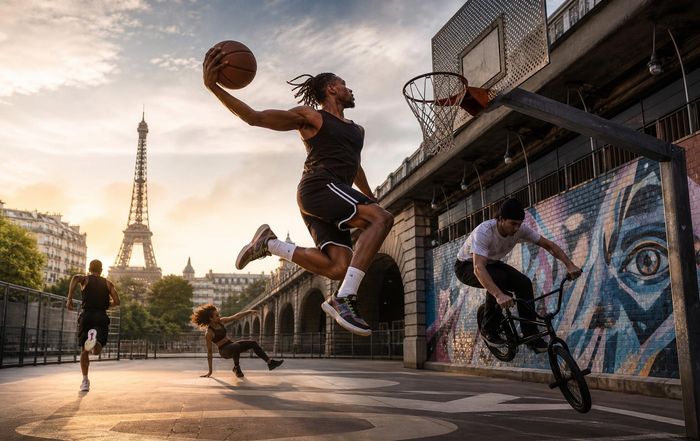
Street Sports in France: Inside the Culture of Urban Competition
From Paris plazas to Marseille waterfronts, street sports have become one of the most visible expressions of contemporary French urban life. Far beyond casual pickup games, they mix performance, identity, social struggle and creative self-expression. For many young people, especially in dense suburbs and inner-city neighborhoods, street competition is not a sideshow to "real" sport; it is the main stage.
This sporty doc looks at how street sports in France have evolved into a distinct culture of urban competition, how they intersect with politics and public space, and why they increasingly matter to federations, brands and cities trying to connect with a new generation of athletes.
From asphalt to identity: how French street sport took shape
Street sport in France did not emerge from a vacuum. It grew out of several overlapping influences: the spread of American hip-hop culture in the 1980s and 1990s, the expansion of mass housing estates (grands ensembles) on the edges of major cities, and the country's long-standing passion for sport as a vehicle of citizenship and social cohesion.
Basketball courts and five-a-side football cages started appearing in and around social housing projects as municipalities sought inexpensive ways to occupy youth and calm tensions. At the same time, breakdance crews, graffiti writers and early BMX riders were already claiming plazas and underpasses as their own arenas. By the 2000s, France had a strong base of streetball, freestyle football, parkour, skateboarding and rollerblading scenes, each with its own codes, heroes and rivalries.
The rise of parkour, often traced back to the Parisian suburb of Lisses and the Yamakasi collective, helped define a distinctly French contribution to global street sport culture. Parkour's focus on efficiency, creativity and reclaiming the city resonated with young people navigating both physical obstacles and social barriers. Meanwhile, streetball tournaments in working-class suburbs around Paris, Lyon and Marseille created highly competitive circuits that were largely invisible to traditional federations but hugely influential locally.
As social media platforms like YouTube, Instagram and TikTok grew, French street athletes found direct channels to audiences without needing clubs or federations as intermediaries. Freestyle footballers, tricking specialists and street workout practitioners turned public spaces into content studios, accelerating the professionalization of some athletes while also intensifying competition for visibility.
The city as playground and battleground
Urban competition in France is inseparable from the geography of its cities. Multi-sport cages, playgrounds, skateparks and open plazas are the main arenas, but so are staircases, handrails, rooftops and riverfronts. The city provides both infrastructure and resistance: concrete, traffic, pedestrians, security guards, weather and surveillance.
In dense neighborhoods, a single fenced football or basketball cage can structure an entire micro-ecosystem. Informal hierarchies emerge around who "owns" the prime playing times, who brings the ball, who controls the playlist. Winners often stay on, losers rotate off, and reputations are built over months of near-daily play. For many teenagers, these cages are more immediate and meaningful than any official club facility, because they are accessible, free and embedded in their social life.
Yet public space is also contested. Municipal regulations, noise complaints and anti-loitering policies can push players away from central areas. Skaters in cities like Paris, Lyon and Bordeaux have long negotiated fragile truces with authorities around iconic spots. The redevelopment of Place de la République in Paris into a large, open plaza turned it into a magnet for skateboarders and BMX riders, but also a stage for political demonstrations, tightening the link between physical expression and civic life.
French urban policy has for years framed sport as a tool against marginalization and delinquency. Government initiatives through the Ministère des Sports and local councils fund street sport facilities and community programs, while organizations like Agence nationale du sport and local associations try to connect informal practice with education and employment pathways. This institutionalization brings resources but also tensions, as some practitioners worry that the raw, self-organized nature of their sports will be diluted when folded into official programs.
Streetball, five-a-side and the codes of urban competition
Among all street sports in France, football and basketball dominate in terms of participation and cultural impact. Yet their street versions operate with different logics than the 11-a-side or five-on-five indoor games governed by the Fédération Française de Football and Fédération Française de BasketBall.
In five-a-side football cages common across French cities, rules are fluid and often negotiated on the spot: number of touches allowed, height of goals, winner-stays-on formats and time limits. Skill matters, but so do physical toughness, verbal charisma and the ability to handle provocation. Nutmegs (panna), humiliating dribbles and improvised celebrations carry social weight beyond the simple scoreline. The cage amplifies sound and emotion, turning even small games into intense spectacles.
Streetball tournaments, especially in Paris and the Île-de-France region, have evolved into high-level competitions with their own stars. Events inspired by or linked to international circuits such as FIBA 3x3 have helped formalize some aspects of play, but most French streetball still thrives on minimal structure: music blasting, MCs narrating, spectators encircling the court at arm's length. Style points-ankle-breaking crossovers, powerful dunks, trash talk-are as important as efficiency. Many professional or semi-professional players cut their teeth in these environments before entering or alongside club pathways.
This culture of urban competition also influences training habits. Players might spend hours working on one-on-one moves, tight-space ball control or step-back jumpers rather than the tactical systems emphasized in clubs. For some, street performance becomes a route to visibility: viral clips can attract scouts, sponsors or invitations to showcase events, blurring the line between competition, entertainment and personal branding.
For readers interested in training that mirrors this intensity, resources on training and performance can help adapt structured methods to more improvisational environments.
Skateboarding, parkour and the aesthetics of risk
Skateboarding and parkour occupy a slightly different space in French street culture. Where ball sports often center on direct confrontation between teams, these disciplines emphasize progression against the environment and oneself, even when practiced collectively. Yet they are no less competitive; the competition simply takes subtler forms.
French skateboarding scenes in cities like Paris, Lyon, Bordeaux and Marseille have long been connected to global networks via brands, magazines and video parts. Spots like Paris's Place de la République or Lyon's Hôtel de Ville plaza function as informal proving grounds. Landing a new trick on a famous ledge or stair set, filming a clean line through heavy pedestrian traffic, or being featured in a respected crew's video can carry more prestige than winning a small contest. At the same time, skateboarding's inclusion in the Olympic Games, overseen by bodies such as the International Olympic Committee at olympics.com, has brought new attention and investment, prompting debates within French scenes about commercialization and authenticity.
Parkour's French roots give it particular symbolic weight. The discipline's philosophy-efficiency, adaptability, overcoming obstacles-has inspired everything from military training to corporate wellness programs. Organizations like Fédération de Parkour and various local associations have pushed for recognition, while municipal governments in places like Paris and Toulouse have experimented with parkour-friendly urban designs and dedicated structures. Still, much of the most respected practice happens informally: rooftop runs at dawn, late-night sessions on university campuses, or creative routes through historic districts where practitioners must constantly negotiate visibility, safety and legality.
Both skateboarding and parkour raise questions about risk and public responsibility. French health and safety authorities, along with bodies like the World Health Organization at who.int, promote physical activity while warning about injury risks, especially among youth. Street athletes often counter that controlled risk is part of learning resilience and that heavy-handed restrictions can push practice into more dangerous, hidden spaces. The tension between protection and autonomy remains a central theme in how French cities regulate street sports.
Freestyle, social media and the new urban influencers
The past decade has seen the rise of a new type of French urban competitor: the freestyle content creator. Whether juggling a football, combining calisthenics and acrobatics on a pull-up bar, or chaining BMX tricks through narrow alleyways, these athletes treat the city as a continuous stage for short-form video.
Freestyle football is perhaps the most visible example. Building on France's deep football culture and diverse urban demographics, freestylers have gained large followings on platforms like TikTok, Instagram and YouTube. Many collaborate with brands, music artists or major clubs, and some appear in campaigns around tournaments organized by UEFA at uefa.com or major sportswear companies. Competitions still exist, but much of the real competition is for attention: who can innovate the most surprising combo, find the most scenic rooftop, or integrate local landmarks into a routine.
Street workout and calisthenics have followed a similar path. Pull-up bars in public parks, often installed as part of health promotion initiatives guided by organizations like Santé publique France and supported by broader European health strategies, have become hubs for informal strength competitions. Athletes challenge each other to perform increasingly complex sequences of muscle-ups, levers and dynamic moves, frequently filmed and shared online. The line between training, competition and performance art blurs.
This shift has business implications. Sports and lifestyle brands, media companies and even traditional clubs monitor these scenes for talent and cultural relevance. Platforms like YouTube and TikTok function as both broadcasting tools and ecosystems where algorithms effectively referee the contest for visibility. For younger practitioners, the dream may be less about joining a professional club and more about building a sustainable creator career around their street skills.
For those looking to connect this performance-driven approach with broader wellness goals, our sections on fitness and lifestyle explore how to balance spectacle with long-term health.
Inclusion, exclusion and the politics of who gets to play
Street sports in France are often celebrated as inclusive spaces, especially for youth from working-class, immigrant and racially diverse backgrounds who may feel alienated from traditional clubs. Access is free, equipment is minimal, and performance, at least in theory, matters more than social status. Many community organizations, including those supported by the Ministère chargé de la Ville and local governments, use street sports as tools for integration, education and violence prevention.
Yet inclusion is uneven. Gender remains a major fault line. Public courts and parks are still overwhelmingly male-dominated, especially in the late afternoon and evening. Women and girls who do participate in streetball, five-a-side, skateboarding or parkour often report harassment, condescension or being pushed to the margins of space and time slots. Feminist and activist collectives have responded by organizing women-only sessions, mixed-gender tournaments with explicit codes of conduct, and campaigns to redesign public spaces to better accommodate diverse users.
Disability access is another challenge. While some skateparks and public facilities in France are designed with adaptive sport in mind, many urban environments remain difficult to navigate for people with physical or sensory impairments. Advocacy groups and federations, including Comité Paralympique et Sportif Français at france-paralympique.fr, push for more inclusive design and programming, but implementation varies widely between municipalities.
There is also a class dimension. Central urban spots that become internationally famous-like République in Paris or the Vieux-Port area in Marseille-can attract tourism and investment, which sometimes leads to policing or redevelopment that displaces the very communities who made the spaces vibrant. Debates over "who owns the city" play out in conflicts between skaters and shop owners, parkour practitioners and building managers, or streetballers and residents complaining about noise.
These tensions intersect with broader questions of ethics and social justice in sport: who is visible, who is silenced, and how public space is allocated among competing interests.
Institutional recognition: from underground to Olympic-adjacent
As street sports have grown more visible, French institutions have moved from skepticism to strategic engagement. The Ministère des Sports et des Jeux Olympiques et Paralympiques has explicitly framed urban sports as a priority, particularly in the run-up to and aftermath of the Paris 2024 Olympic and Paralympic Games. The Olympic program's inclusion of skateboarding, sport climbing, BMX freestyle and 3x3 basketball-governed internationally by bodies like World Skate at worldskate.org and FIBA at fiba.basketball, and nationally by relevant French federations-has accelerated funding and infrastructure projects.
French cities have invested in new skateparks, climbing walls and 3x3 courts, often in neighborhoods previously underserved by sports facilities. Some municipalities have hired "urban sports coordinators" or partnered with local associations to organize festivals, demos and mixed events that combine competitions with music, art and food. Federations have created urban divisions or commissions to better understand and support these disciplines.
However, institutional recognition brings trade-offs. Formal competitions require rules, rankings, insurance and sometimes membership fees, which can exclude the most precarious participants. The aesthetics of street sport-graffiti, loud music, late-night sessions-may be sanitized in official events to fit sponsor expectations or broadcast standards. Long-time practitioners sometimes feel that their culture is being appropriated without adequate recognition or compensation.
Brands and media also play a growing role. Major sportswear companies, energy drink brands and tech platforms sponsor tournaments, teams and individual influencers. Traditional broadcasters and digital outlets like L'Équipe at lequipe.fr and Canal+ at canalplus.com increasingly feature urban sports content, from documentaries on parkour crews to live coverage of 3x3 basketball. This visibility can create new opportunities for athletes but also intensifies commercial pressures and narratives that may not reflect everyday realities in French neighborhoods.
For readers interested in the intersection between sport, business and brands, the evolution of street sports offers a clear case study in how grassroots cultures are integrated into formal sports economies.
Health, performance and the hidden workload of street competition
Behind the spectacle of urban competition lies a demanding physical and mental workload. Street sports often involve high repetition of explosive movements, frequent falls or collisions, and irregular training loads dictated by weather, access to space and social schedules. Unlike club environments, there may be limited access to medical support, structured warm-ups or long-term planning.
Research from organizations such as Inserm at inserm.fr and international bodies like the World Health Organization underscores both the benefits and risks of intense physical activity in youth populations. Regular participation in street sports can improve cardiovascular health, coordination, strength and mental well-being. At the same time, overuse injuries, ankle and knee problems, and head impacts are common in disciplines like basketball, football, skateboarding and parkour when load is not managed.
Nutritional habits and recovery practices vary widely. Some high-level street athletes adopt professional routines-sleep monitoring, mobility work, targeted strength training-often learning from online resources or mentors. Others train and compete intensely with little attention to rest, hydration or injury prevention, especially when social pressure to "show up" and perform is strong. Access to healthcare can be uneven, particularly for undocumented youth or those in precarious economic situations.
Mental health is another under-discussed dimension. The competitive atmosphere in cages, on courts or online can be both motivating and stressful. Public failure-missing an open shot in front of the neighborhood, bailing a trick off a ledge, or posting a clip that draws ridicule-can carry social costs. For athletes trying to build a digital following, algorithm-driven metrics add another layer of pressure, linking self-worth to views and likes.
Connecting urban practice with evidence-based health and fitness information is a growing priority for community organizations and practitioners alike. Workshops on injury prevention, mental resilience and nutrition, often delivered in partnership with local clinics, NGOs or health agencies, are becoming more common in French cities.
Where French street sport goes next
French street sports sit at a crossroads. On one side lies the raw, improvised energy of pickup games, DIY spots and night-time sessions that have long defined urban culture. On the other stands an expanding ecosystem of federations, brands, media and public institutions eager to harness that energy for participation targets, economic growth and international prestige.
How this tension is managed will shape not only the future of urban competition but also broader questions about youth culture, public space and social cohesion in France. Will street sports remain primarily tools for social policy, or will practitioners gain more direct influence over how their disciplines are governed and represented? Can cities design spaces that welcome diverse users-women, people with disabilities, older adults-without diluting the intensity that makes these environments compelling? And how will climate, economic and technological changes affect the way young people move through and compete within their cities?
For athletes and enthusiasts, the immediate reality is more concrete: a new court opening in a nearby park, a local skate crew resurfacing a ledge, an upcoming 3x3 or freestyle tournament promoted on social media, or simply tonight's run of games in the neighborhood cage. Urban competition in France is ultimately lived one session at a time, in the friction between bodies, concrete and community. Sport fans who want to explore adjacent themes can dive into our daily content of sports, culture, world trends and the evolving technology shaping how we play, watch and share sport in the city.